Open Letter to Oklahoma Voters and Lawmakers

Given the current government’s gouging of public education funding, in one of the richest provinces in one of the richest countries in the world, there will be many more teachers here in BC writing letters like this soon enough.

Steven E. Wedel's avatarSteven E. Wedel

I am a teacher. I teach English at the high school of an independent district within Oklahoma City. I love my job. I love your kids. I call them my kids. I keep blankets in my room for when they’re cold. I feed them peanut butter crackers, beef jerky, or Pop Tarts when Michelle Obama’s school breakfast or lunch isn’t enough to fill their bellies. I comfort them when they cry and I praise them when they do well and always I try to make them believe that they are somebody with unlimited potential no matter what they go home to when they leave me.

What do they go home to? Sometimes when they get sick at school they can’t go home because you and the person you’re currently shacking up with are too stoned to figure out it’s your phone ringing. Sometimes they go home to parents who don’t…

View original post 1,104 more words

Changing Schools from the Inside Out

A year ago this month, based on the international popularity of a blog I had written for Huffington Post,  I was invited to speak at two conferences in Italy. And so it was that in October 2015 I travelled to Europe and presented my teaching ideas in Milan,  in Ferrara and in Florence. The above video was filmed in Ferrara and in Florence.

Sharing my ideas in Italy was quite a surreal experience because I had held these ideas for most of the three decades of my teaching career but had always encountered massive resistance to them from colleagues and from superiors whether in South Africa or in Canada.

But something has shifted within the education system and so what was considered too radical years ago is now being welcomed as a great new idea: that classrooms should be spaces that students find socially inviting, emotionally safe, and intellectually stimulating.

This coming summer I’ll be sharing these ‘radical’  ideas during a three-week course I’ll be teaching at the University of the Fraser Valley as part of their Teacher Education Program.  The course, Changing Schools From the Inside Out will explore spaces where change is possible despite restraints within the education system.

A few of the practices I use in my high school classroom will be embedded into the course: journalling, movement, meditation, and laughter.

The three hour class each day will be divided into time to share within the circle, time to listen to a lecture, and time to practice and/or explore new ideas.  Gather, Think and Do, respectively.

I am very excited about this opportunity to teach and to learn with other teachers and am looking forward to showing what I’ve learned through “chart and chance” over my career.  As Ken Robinson has said:

Opportunities for change exist within every school, even where the emphasis on high-stakes testing has become extreme. Schools often do things simply because they’ve always done them. The culture of any given school includes habits and systems that the people in it act out every day. Many of these habits are voluntary rather than mandated – teaching by age groups, for example, or making every period the same length, using bells to signal the beginning and end of periods, having all of the students facing the same direction with the teacher in the front of the room, teaching math only in math class and history in history class, and so on. Many schools, a good number of which are dealing with adverse conditions and were once considered trouble, have used that space to innovate within the system, often with inspiring results. Innovation is possible because of the sort of system that education actually is. ~~~ Ken Robinson in Creative Schools.


Dear Teens

http://publicdomainarchive.com/public-domain-images-woman-earth-globe-white-short-outdoors-water-reflection/
http://bit.ly/1KAzfNf

I see what you’ve been doing. I’ve been noticing it for a while now. Almost weekly you are solving intractable problems that have had adults stymied for years. A cheap way to check for pancreatic cancer. Stopping the spread of germs on planes. Cutlery that scans for bacteria.  A rain and fireproof sleeping bag for the homeless. The list gets longer each time I look.

And what amazes me is that even when you don’t have many resources, you’re re-inventing the world. You’re doing it with scraps from dump heaps and in places where there are few books and only occasional electricity.

I’m envious. You’re just newly arrived here on this planet and yet you seem to see much more than we who have been here for many decades. Perhaps we have become jaded or too resigned to the world we know?

Of course it helps that you don’t have to invent mathematics. Or the printing press. Or the Internet.  With easy access to the collective pantry of human ideas, you are deftly repurposing and reconfiguring what you find here.

And you do this despite what you learned in kindergarten, one of the first lessons in school: stay inside the lines. Luckily for us, you realize that colouring outside the lines can create a completely different picture. It’s outside conventional lines of thought that creative solutions lie. As you are well aware, it’s outside we’ll all have to go if we have any hope of leaving a livable planet for your children.

You’re quite concerned about the state of the planet you find yourself on and so apart from all the scientific breakthroughs you’re making, you’re also stirring change socially and politically in ways that sometimes stuns.

Those of us who are watching you know that Malala Yousafzi is not an anomaly, that there are many like her who refuse to accept the norm as normal for young women.  We know not all 12-year-olds can start an organization like Free the Children but there are many more like Craig Kielburger who want to end social iniquities such as child slavery. We know that First Nations youth are “idle no more” despite their inheritance of a painful legacy. And we know that Victoria Barrett, who is suing the Obama administration, is at the vanguard of youth demanding that something be done to mitigate climate change.

There are multitudes of you with many brilliant ideas but too often those ideas are being buried beneath your boredom and frustration in schools. It was no surprise to see in a recent study by Yale that 75% of you are either bored or frustrated or tired in schools.  It’s certainly no surprise to Sir Ken Robinson who has for decades been urging schools to allow you to be who you are: creative problem solvers.

But despite his message resonating with teachers worldwide, too many politicians insist that you become human calculators, writers of the 5-paragraph essay and memorizers of the information you can access within nanoseconds on that device in your pocket.

It’s no wonder that many of you are tired. I would be exhausted every day if I had to adjust and adapt to a new environment every hour as you do in schools. How do you cope with being in Biology for an hour and then completely changing your train of thought to adapt to French or Physics in the next hour? How do you adjust to the emotional climate of so many different classrooms and teachers each day? The effort must be daunting!

I wish that schools nurtured your creativity instead of punishing it.  I wish that you were given time each day to allow your ideas to gestate. And I fervently wish that public schools were funded as a priority so that you had all the tools you needed to show us what we cannot see.

If these wishes came true for all of you and not just a few, I can’t imagine what you could do.

But I bet you can.

In admiration,

A Teacher

Take the Leap

leap

She had tears in her eyes when she said, “I wish I could teach like you do but I’m too afraid”.

I didn’t know what to say and mumbled something that probably did nothing to assuage her grief as I hugged her.  I’d like to try to say something in response now.

On the long road that led to being invited to Italy to share my teaching ideas, I too shed many tears. I know very well what it feels like to be overwhelmed by the enormity of our task and the impossibility of ever doing enough for every student in our classrooms. And I too have an abject fear of failure.

But what I hold on to when I take that leap into the unknown every time I try something new in my classroom, is my extreme distress at the discomfort so many of my students experience in school,  and my ongoing irritation at the waste of their creativity.

Have you noticed lately how often there is news of yet another discovery or invention by a teenager? How many more could there be if we could stop force-feeding them boredom and instead unleashed their minds to look anew at the intractable problems of our world?

I wonder how many teachers, after hearing Ken Robinson’s plea for us to nurture creativity in schools, take the leap into innovating their teaching practice? Since February 2006 the talk has been viewed over 36 million times and translated into 59 languages but I’m curious about what its impact has been on the critical core of education systems: the relationship between teachers and students.

That’s where the “frontlines” of innovation actually are: the space between a student and a teacher. It’s what I find in this space that motivates me to keep trying to change what happens in schools.

In that space hangs the question each student asks of me: Do you care?

It doesn’t matter if you’re a taskmaster or a laissez faire teacher, a charismatic John Keating (Dead Poet’s Society) or a demanding Jaime Escalante (Stand and Deliver),  caring comes in many colours in classrooms.  And, luckily,  students are caring colourblind – they’ll take any colour of caring that they can get.

They really don’t need all the technological tinsel promoted during too many professional development workshops. They may enjoy the novelty of it but when that wears off, they’re back to wondering whether you, their teacher, care.

Care is one of those words that can have many interpretations but what I mean does not include unicorns and rainbows.

Caring is pragmatic. Even if I can’t change the entire system today, every day I can ensure that my students, in my classroom, are as comfortable as possible by allowing them to move, to eat, to take brain breaks. I can choose to be aware of what they need as human beings, not as empty vessels to be filled and tested.

Caring is challenging. It requires me to put myself in another’s shoes, to be compassionate, empathic; to see the other, my student, as I would want to be seen. Even when, and especially when, that student is recalcitrant.

Difficult students have been my most memorable teachers because conflicts with them have been the catalyst for my excavation of who I am as a teacher.

This excavation is necessary because it’s where all change, anywhere, begins. From the inside out.

So if we are to change education systems, yes, it’s important that there is political and economic support for change, that there is social support for innovation, and that enough time is also provided for teachers to explore new ideas, but what is most critical of all is that each individual teacher gather up enough courage to override her fears about changing what she does each day in her classroom.

Because change requires courage.

The kind of courage that Brene Brown talks about in another famous TED talk. The kind of courage that requires the willingness to be vulnerable, to risk being hurt.

The kind of courage lubricated by tears.

And, dear colleague, when you’re ready to take that courageous leap, I’ll be there to hold your hand.

We’ll take that leap together.

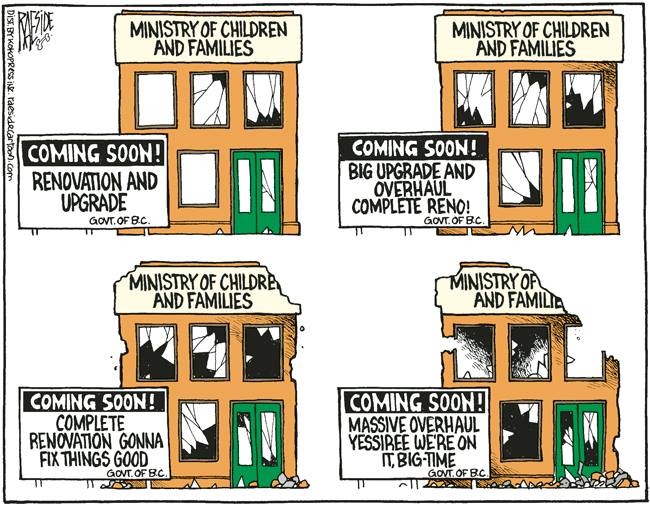
The children that Christy Clark forgot

broken ministry cartoon
Image courtesy Raeside cartoon.com

I’m thinking of the students who wish school was open today. The  ones whose only meal each day is the one they get through a school meal program.

I’m thinking of the one in five B.C. children living in poverty who Santa Claus will forget. The ones for whom Friday will be just another hungry day in one of the most affluent places on earth.

I’m thinking of the mother who works at least two jobs and yet still can’t provide more than the bare necessities for her children.

I’m thinking all this while a vivid childhood memory whirls in my head of my mother singing Nat King Cole’s The Little Boy that Santa Claus forgot:

He’s the little boy that Santa Claus forgot

And goodness knows, he didn’t want a lot

He sent a note to Santa

For some soldiers and a drum

It broke his little heart

When he found Santa hadn’t come

In the street, he envies all those lucky boys

Then wanders home to last year’s broken toys

I’m so sorry for that laddie, he hasn’t got a daddy

The little boy that Santa Claus forgot

Premier Christy Clark is probably hoping that we have forgotten about her broken promises.  She won’t want us to remember what she said about putting “families first” in her last election campaign. Or how she offered parents $40 a day while she kept their children out of school in her attempt to get teachers to back down in their fight for more educational support for children.

What she fails to realize is that for thousands of children in this province, school is much more than a place they go to learn an approved curriculum.

They are the students who come early and leave late each day because school is where the peace and quiet is.

The students who count 24 hours between meals.

The students who teachers have in mind for every Adopt-a-School request for funds.

The students who are expert couch surfers, relying on the compassion of the parents of their school friends.

They certainly can’t rely on the compassion of a premier who spends thousands of dollars to take her son on a trip to the other side of the world so that he can learn empathy.

If we accept the view of honorary Canadian citizen, Nelson Rolihlahla Mandela, who said that “there could be no keener revelation of a society’s soul than the way it treats its children”, then what are we to say about the soul of the province of British Columbia  when news about yet another child dying while in the custody of the Ministry of Children and Families elicits nothing more than a shrug from the government?

During this Christmas season, when the birth of a child is celebrated with much largesse, I think about the children this government has conveniently forgotten.  

When the  BC Liberals, in their bid for re-election in 2017, spin all the facts of their malfeasance, when they whitewash the 15 years of cuts they have made to services for children,  I hope that voters will remember the children that Christy Clark forgot.

Lazy Teaching

lazy teaching
http://www.imcreator.com/free/education/phone-home


I was accused of lazy teaching this week. The accusation came along with an outburst of frustration from some students after I had suggested that I would send a video link in response to a Question Box question: 


[When] you said “I will send you a video on this question” I wanted to scream. I look forward to Question Box because that’s when you talk to us and explain so thoroughly and it’s like a rollercoaster. You take us to places where our brains would never have gone on their own. You explain to us with emotion, something a random guy on the Internet cannot do. When you show us videos you take the lazy way out.

Any teacher is capable of sending a link of a video or giving us something from the textbook but if you are capable of actually explaining (which you are) then do it!

I don’t even understand anything a guy is saying in a video cause they talk fast and just say useless facts but you don’t. You explain, you connect.

I always talk about you and have something to say but that won’t happen if you become an ordinary teacher. Don’t be lazy!

I hate videos because they don’t have the same impact as someone who actually talks and interacts with us. Also, you were basically giving us advice and I’d rather have advice from someone I know and have known a bit and understand rather than someone who doesn’t know me. I can’t take their advice seriously because they don’t know me and I don’t know them.


I wonder if the proponents of ‘personalized learning’ know this about the way students who are digital natives prefer to learn?

Salaam Alaikum, Sajjal.

mary and jesus in persian miniature
https://en.wikipedia.org/wiki/Mary_in_Islam

Dear Sajjal,

I wonder how you bear it all each day.

I had forgotten how much hate eyes can spew. I thought I would be able to do what women in Sweden did after a pregnant Muslim woman was viciously attacked. I thought that I too could show my support for you and all Muslim women by wearing a scarf on my head in public.

I lasted two days.

I’m sorry.

I have not felt so scared in public in a long time.

It was easier to spot a racist when I grew up in South Africa. Quite ‘normal’ to assume a certain demeanour around White people, to be guarded and careful not to do anything that may invite an attack.

After being here for 25 years, I’d let that guard down, settled into feeling safe, protected by the Canadian Charter of Rights and Freedoms.

But when I covered my hair with a scarf as I went about my day this week, I felt as though I had a target on my head.

What is it about the scarf that incites such hatred?

I’m not sure if you know this but in Ancient Greece a women’s head covering was called a himation, although what Mary wore on her journey from Nazareth to Bethlehem was called a mantle. (By the way, I didn’t know that Mary is mentioned more often in the Quran than she is in the Bible!)

In Medieval Europe women covered their heads and necks in a wimple but in many places in Eastern Europe today it’s called a babushka, in Spain a mantilla, in India a pallu.

Whatever it’s called, the tradition of a woman covering her head as an indication of piety and modesty has a long history. But in the future historians will note that when Muslim women covered their heads in the early 21st century, they were targeted for vicious attacks whilst Christian nuns who cover the heads in habits, do not suffer the same fate.

If you were still my student and I still your teacher, we could explore the roots of the hate through Media Studies. It would be quite an easy exercise to find multiple examples of how the media has been magnifying the hate while all but ignoring the voices of reason and compassion.

But I know that understanding would not make the indignities any easier to bear.

I’m sorry that what I taught you about human rights and civil rights can provide no comfort or protection from the ignorance and fear that fuels the hate you experience daily.

You have quite an insightful mind so I would not be surprised if you wonder at the irony of the upcoming Christmas celebrations when there will be images of Mary everywhere.

Mary, with her head covered,  seeking shelter.

I know that your big heart will lead you to do all that you can to help the Syrian refugees who are about to find out what you already know about the two kinds of Canada – the one that vilifies women who cover their heads, and the other that celebrates the birth of the son of one with wishes of peace and joy.

I would love to be able to do more than just wish you peace.

But a wish for peace is all that I have now.

Salaam Alaikum, Sajjal.

A Christmas Story

goat
http://mediaincanada.com/2012/11/06/plan-canada-promotes-gifts-of-hope/

I got a goat for Christmas once. It came with a bottle of wine. I enjoyed drinking the wine but didn’t actually see the goat because it was sent on my behalf to a family who really needed its milk to survive. I thought about the family and the goat while listening to Christmas music in a store yesterday. Wondered if the goat had really made a big difference in their lives, as advertised.

When I was a child, I remember feeling an overwhelming sadness whenever my mother sang Nat King Cole’s The Little Boy that Santa Claus forgot. I remember being baffled about how anyone could not have presents under the tree, when I had so many. Even now, decades later, my heart hurts whenever I hear that song.

The Christmas season is complicated for me. I struggle to reconcile the lavish consumption with the stark realities of the suffering of millions.  I can’t seem to connect the dots between the messages of peace, joy and love with the lack of compassion for those unlucky enough to be born in places that are war-torn.

For half my life Christmas was the season of summer, hot days and nights, beach picnics, surfing Santas on gift wrapping paper. The pictures of snow and holly trees on the Christmas cards  we received seemed to come from another world. I remember wondering what it must be like to live in such a world, it seemed so peaceful.

Peace was not a concept that had much real word meaning for many of us. We lived in constant anticipation of the next explosion, the next arrest of political activists fighting the Apartheid regime.

Peace has been a much more tangible concept for me since I came to Canada but a month after an election that was in some sense a test of Canadian values, we are faced once again with questions about what kind of Canada we live in.

Days after the horrific attacks in Paris, petitions are circulating calling for the cancellation of the promise of sanctuary for 25 000 people, refugees whose homes had become the sites for daily attacks like the one in Paris, the one in Beirut, the one at Garissa University in Kenya.

I wonder if those signing the petitions are also signing Christmas cards wishing others peace, joy and love at Christmas?

I wonder if they remember the details of the Christmas story: a Middle Eastern man, seeking shelter for his pregnant wife.  The story of the many who turned the strangers away, the one who offered sanctuary.

Many Arabs offered sanctuary to Jewish people during the Holocaust, sometimes disguising them as Muslims to take them to safety. Would knowing facts like these help to open the hearts and minds so closed to welcoming refugees?

A Christmas shopping catalogue arrived in my mailbox this week. It’s filled with wonderful images of happy families sitting around in beautiful clothing. The message is that if I buy the clothing, I too will have a happy Christmas.

I’d rather get a goat.

When fear and ignorance fuel hate

fear ignorance hate
https://pbs.twimg.com/media/BzJEvEXCYAA7jYd.jpg

The man who spat at her didn’t know her. He didn’t know her name or the fact that it meant ‘beautiful’ in Urdu. He didn’t know that she was a talented artist and a brilliant student. He didn’t know about all her hard work raising funds for cancer research or the long hours she spent increasing environmental awareness in our school. He knew nothing of this. All he knew was that she was wearing a hijab and her choice to do so made her a target for his hatred.

Days after the 9/11 attacks, an American-Sikh man, Balbir Singh Sodhi, was killed by someone who told friends he was going out “to shoot some towel heads”. Beyond the fact of the killer’s ignorance of the difference between Sikhism and Islam is the fact that the killer’s religion was not cited as a reason for his attack.

In these hours after the attacks in Paris, I wait with bated breath for the hate attacks to begin, as I know they will. I tense as I scroll through headlines, hoping I don’t see anything like “Pregnant Muslim woman attacked by Montreal teens”.  I hope that instead I see headlines like “Train passenger defends Muslim woman against hateful rant”. I hope I see more of those.

But history shows my hope may be in vain. There have been too many times in our Canadian history, in battles between hate and compassion, when hate won.

It won when the Komagatu Maru, carrying British citizens of the Sikh faith, was turned away in Vancouver in 1914. It won when the St. Louis, carrying Jewish people fleeing Nazi occupied Europe, was denied entry into Halifax in 1938. It won when Japanese Canadians were interned after the Pearl Harbour attack despite the fact that the RCMP said that they posed no threat to Canada in 1942.

Will hate win again now in the aftermath of the horror of the attacks on Paris?

Online comments on Prime Minister Trudeau’s response to the attacks leads me to believe that it may. The commenters say that we should stop the immigration of Syrian refugees. They claim that the refugees are just terrorists in disguise. I wonder if the commenters have met a refugee?

There are 60 million refugees waiting in thousands of camps all around the world today. People who were engineers, doctors, teachers, students, farmers, shopkeepers before they were refugees.  People who were going about their lives, working, studying, raising children, when war or famine made that daily life impossible.

The Syrian refugees, like millions of others, fled their homes after a multitude of attacks like the one in Paris. A multitude of attacks that did not get wall-to-wall media coverage here.

As I write this, the furnace has just clicked on, the kettle is whistling and I’ll soon be enjoying a nice cup of tea while I read the newspaper in peace and quiet. But my enjoyment of this ordinary pleasure will be tinged with anxiety about how my fellow Canadians will respond to hatred’s rally call.

In the recent federal election, the Harper Conservatives used a niqab to fan the flames of hatred, but Canadians overwhelming rejected that attempt to divide citizens from each other.  Does that rejection still hold today?

I worry about my students, the ones who wear the hijab, who wear a turban, who are visibly different to a racist view of what a Canadian looks like.  

I wonder what my students think about our Social Studies lessons on the rights and responsibilities of citizenship in Canada. I wonder if they have developed some cynicism about all the claims made about who and what the Charter of Rights and Freedoms protects.

Canada’s 2015 election was historic for many reasons other than its length. At the end of it, Canada had a cabinet that “looked like Canada” in all its diversity.  Is it too much to hope that we can continue to see that what it means to be Canadian includes a diversity of colours and creeds?

My student shrugged at the end of telling me the story of that hate-filled attack on her. She seemed resigned to its reality. I wish more than anything else in the world that she didn’t have to be.

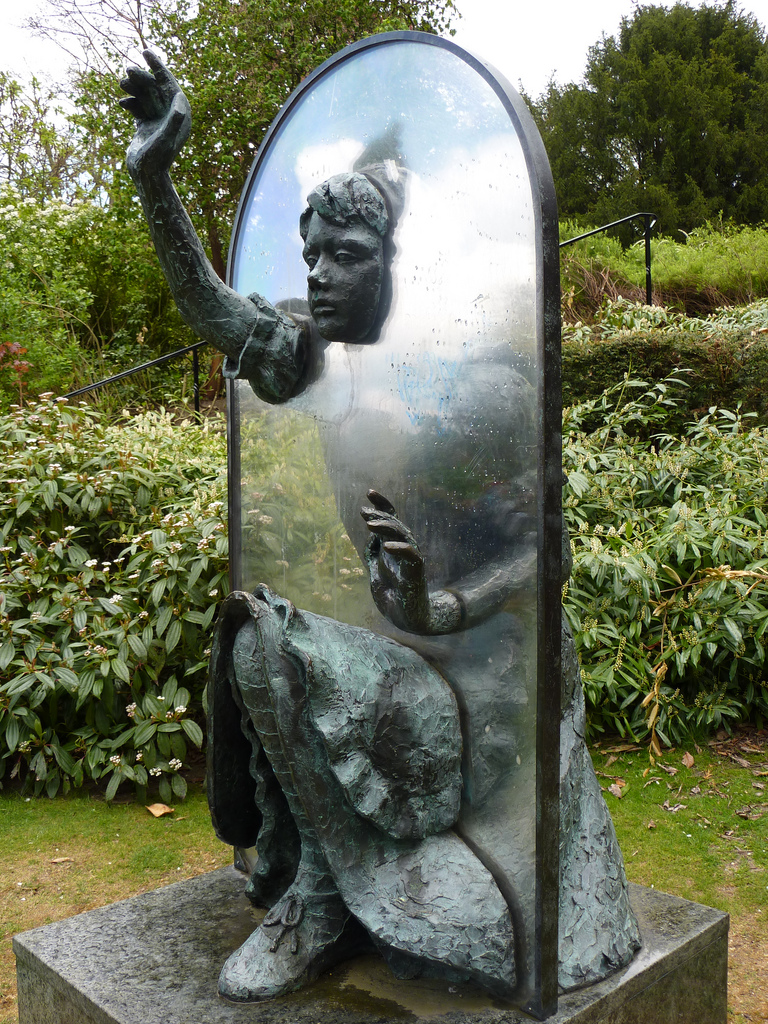
Cellphones: Alice’s Looking Glass in the 21st century

alice looking glass
http://www.geograph.org.uk/photo/2859504

I’ve been haunted by the images in the videos taken in the classroom at Spring Valley High  while a police officer, called to the classroom because a student refused to give up a cellphone, is seen violently throwing the student around.  That the student had been recently placed in foster care made the event that more tragic. In one of the videos, one can see the back of the teacher who had supposedly called on the principal when the student refused to put her cellphone away. When the principal could not convince the student to give up her phone, the police officer was called.

The incident made international news on Monday, 26th October, a day after Yale University Center for Emotional Intelligence released a study that revealed that 75% of students in Grades 9 – 12 felt either tired, stressed or bored at school.

Did the student who refused to give up her phone feel bored or stressed or was she just feeling lonely?

I had long been aware that students would use their cellphones when they felt bored but it had never occurred to me that they may also do so because they felt lonely. But loneliness was one of the reasons my students gave for why they use cellphones in the classroom when I asked them to respond to a totally unscientific survey I conducted after a classroom discussion about the Spring Valley incident.

Although there are many discussions within education about whether teachers should or should not allow students to use cellphones in the classroom, and despite there being a growing awareness of the connection between emotions and learning, what may be missing is a conversation about connections between students’ emotional experiences in the classroom and what could be called students’ addiction to their phones.

While some students told me that they use their phones to “look up” something or to check spelling or for calculations, many students told me that they use their phones as an escape out of the classroom when they’re feeling bored or lonely. As this student says:

I use my cell because even though it might not be allowed in my class, I get the urge to check it because I always think there might be a message from a friend. But sometimes I guess I’m so used to it, I just automatically assume that I need to use it. Sometimes when there’s nothing to do in class because I’ve done my work or my test, I’ll use it for entertainment or to seem like I’m not just sitting there with nothing to do.

Like when I go to French 10, I don’t really talk to a lot of the grade 10s and so I go on my phone to distract myself or to make it seem like others think I actually have a life. … I can’t live without a social life. I need people to converse with so I can have a better time in class or school itself.

So it appears that, apart from all the features normally advertised, a smartphone can also act like Alice’s Looking glass and transport students out of the classroom into another world, one where they have a social life and are not bored or lonely.

But why can’t classrooms be places from which students do not want to escape? Why can’t they be places of excitement and engagement, the way they look to a 5-year-old on the first day of kindergarten?

What is being revealed about what is happening in  high school classrooms when a police officer is called to discipline a student? Not because she had a gun, not because she was being violent, but simply because she refused to give up her cellphone, her escape route from boredom and loneliness.  

What will it take to create classrooms that students want to run to, not escape from, classrooms that are the entry into a world on the other side of the Looking Glass?