Change from the Inside

empty classroom
http://www.imcreator.com/free/education/empty-classroom-2

(This blog is a complement to  Dear Students published in Huff Post) 

What do we teachers do while we wait for politicians to agree with us that 19th century school structures are obsolete in the 21st century, and that creativity, not competition, is what we should be nurturing in students?

We change the system from within.

First, we do the work inside ourselves when we gather up our courage to release our role of  content deliverer and accept that we need to be in constant role change in our classrooms: sometimes a facilitator, sometimes a mentor, sometimes a host creating a safe space for learning to happen.

Decentering our classrooms in this way is difficult work, and is never complete. It’s not a one-day Pro-D affair. It requires vulnerability to realize that we need not be  the fount of wisdom in the front of the room.We need to be  patient but persistent with this work.

We share our decentering ideas with our colleagues so that we put the magic of combinatorial creativity to work. We remix ideas from here and there to find what will fit with our students in our classrooms. There’s a lot of trial and error involved with this. Lots of reading too.

We know that this is a Sisyphean task; sometimes that rock will roll all the way down the hill. But we have to get up and do it again. And we will, with help from our friends and allies who know why we do what we do and why it’s worth the struggle.

I was “lucky” to have been both a student and a teacher in South Africa during Apartheid because there I developed my tendency to read between the lines of any curriculum and to constantly seek ways around stifling restrictions and impositions in schools.

You may think that there is a world of difference between the education system in South Africa and in Canada, until you remember that both Canada and South Africa are former British colonies and both countries imported the same industrial model of education. Much of what I do now in Canada is a further refinement of what I did in South Africa when I became a teacher by accident. But that’s another story.

There is nothing that a teacher can do about the way a school day is divided, but there is a lot that a teacher can do when shaping each day in her classroom.  I teach the humanities to teens  in a school that has “inner-city” characteristics. We have four teaching blocks a day: two in the morning and two after a 40 min lunch.  Each block is 77 mins.

My classroom activities are dependent on which block of the day it is. Sometimes there is a lecture, sometimes an experiential activity, sometimes a check-in to see where everyone is at, sometimes a nap or meditation before any work is done. My decision of what to do when is guided by neuroscience research about how teen brains work. They do not work at full capacity first thing in the morning or during the last block of the day, so I save us all the struggle by not lecturing at those times.

I use my classroom space like a Star Trek holodeck. Sometimes it’s a laboratory, sometimes a country, sometimes a court, sometimes a parliament and sometimes a lounge where conversation happens. It is of course sometimes just a classroom!

I encourage students to ask me questions either directly, through email or anonymously through the very popular Question Box. Questions from students provide me with  insights into their concerns and what I’m missing in my teaching. A colleague who teaches Math adopted and adapted this idea, but her box is called the Panic box – where students place “panic button” questions about course content.

I do very little lecturing and try as much as possible to convert the curriculum in a way that allows my students to engage in Problem-Based Learning and Experiential Learning. When I first started doing this, I didn’t know that that was what it was called! Often times I “make the road while walking”, trying to find ways to bring meaningful learning experiences to my students.

In my dreams, I see Problem-Based Learning and Experiential Learning as the foundation of what is done in public schools in the future.

And I do hope, despite the concerted campaign to defund public education, that we manage to hold on to public schools. They are still critically important, despite their many flaws.

Public schools are much more than places where accredited learning happens. They are a safe space for students whose home lives are difficult; they are the oasis in dangerous neighbourhoods; they are where many students eat their only meal each day and where they can speak to an adult about their fears and concerns.

Public schools are some of the few public spaces we have left that still function as a commons, a space for people, not for profit.

Where else but in a public school can a teen who gets a $30 000 car for his 16th birthday sit next to one who eats only three meals a week?

With so many of our common spaces being taken over by corporations, a public school is a vital social space for many students. It is still the great societal leveller where students from diverse backgrounds can meet on common ground.

The education system has to change, it’s true, but let’s work to repurpose it. Let’s not throw the cup out with the cold coffee.

Let’s change the system from the inside out.

Can Teachers Save Civilization?

Road

(An updated version of this post is published by Huffington Post BC)

[T]he task is to articulate…an alternative worldview to rival the one at the heart of the ecological crisis – embedded in interdependence rather than hyper-individualism, reciprocity rather than dominance, and cooperation rather than hierarchy. …Because in the hot and stormy future we have already made inevitable through our past emissions, an unshakeable belief in the equal rights of all people and a capacity for deep compassion will be the only things standing between civilization and barbarism. (This Changes Everything, page 462)

Naomi Klein may not have had our public education system in mind when she made this call to action in the final chapter of her book This Changes Everything  but let’s consider the possibility that our public schools could provide a place for the exploration and practice of an an alternative worldview, one that could save civilization.

What if, to prepare our children for the complete restructuring of our political, economic and social systems necessitated by the climate change crisis, the dominant paradigm in schools was not competition for grades but instead collaboration to solve real problems?

What if, instead of preparing students to be careerists and consumers in an extractivist economy, schools focused instead on preparing our children to be global citizens, aware of how their choices and actions impacted the lives of all other global citizens?

What if, instead of teaching our children the traditional literacies – reading, writing, numeracy – we also taught them ecological literacy, social literacy and emotional literacy, and other ways of “reading the world“?

And what if we did all this within the framework of ubuntu, the African philosophy that suggests that I am because we are, that my ongoing existence depends on the existence of others?

Could adopting the  ubuntu worldview save us from  the slide toward a state of barbarism that will inevitably exist should the climate change predictions of the Pentagon and the Intergovernmental Committee on Climate Change (IPCC) be allowed to come to fruition?

Imagine a school where students are competent not only in reading, writing and arithmetic, but are also able to “read” the land around the school, noticing when there are changes in the natural environment and what those changes mean.

Imagine schools where diverse groups of students, guided by teacher-mentors, worked collaboratively on projects that solved actual problems, gaining valuable experiences while doing meaningful work.

Imagine schools where project-based learning and place-based education were not the exceptions that they are now but instead were part of a seamless connection between classrooms and the communities surrounding schools.

These innovative teaching practices are just a few of many that teachers have developed while simultaneously having to contend with multiple challenges in public schools brought about by a neoconservatist assault on public education everywhere.

Teachers are always keenly aware that they are midwives for their students’ futures. Now, more than ever, they need to be supported in the work that they do to prepare students for a chaotic and challenging future.

Instead of defunding public schools and bashing teachers, wise politicians, guided by an enlightened public,  should realize that teachers, not corporations,  are critically important to our future.

There is no economy without an environment.

Our children’s future lives depend first on there being a livable environment. In contrast, corporate profits depend on the denuding of our land, the pollution of our water and of our air.

The kind of world we will all live in by the time our kindergarteners graduate will depend on who and what we as a society choose to support on the road to the future.

The choice we collectively make will change everything.

We Are All Connected…

http:::www.imcreator.com:free:nature:sunrise-3

 Anyone who spends time with children or teens knows that they sometimes say the most profound things, perhaps without actually meaning to. It’s as though their eyes can see the world in ways no longer possible for those of us who have fully conformed to conventional ways of thinking, those of us who no longer see the ordinary magic that surrounds us.

Each year I am reminded of this ordinary magic when I take my students on a three-day camping field trip. Even though it’s the most exhausting and stressful thing I do – imagine being responsible for 30 teens for 72 hours – I know that their experiences at camp will be what they remember for the rest of their lives. They come back to school each year to tell me so.

There is nothing extraordinary about the camping field trip. They canoe, complete a high ropes course and engage in various teamwork challenges. But it’s what happens to them in between these activities that they remember most of all.

In teenspeak it’s called bonding. And, as in all words that teens repurpose, its meaning goes beyond what may conventionally come to mind, of two or more things being fused together.

When I first heard the term I had to ask a lot of questions before I fully understood what it meant. Teens don’t always articulate clearly the full meaning of what they’re trying to express.

Bonding, I learned, is what happens when they stay up all night (despite my best efforts to discourage this)  talking to each other. The topics of these talks range from the silly to the sublime but no matter where they begin, they end in a deeper understanding of each other. They get to this place of understanding when they learn how much they have in common with each other; how so many of them have similar struggles, the same concerns and worries. They learn that they’re more alike than not, that their families and circumstances are similar despite cultural divides.  It’s this deep understanding of each other that leads them to experience what they call bonding.

Scientists would have a different way of describing these “bonds”, the ties that bind us to each other.

Neil deGrasse Tyson says it’s the most astounding fact – that we are all not only “bonded” to each other but indeed that we are “bonded” to the whole universe:

“Recognize that the very molecules that make up your body, the atoms that construct the molecules, are traceable to the crucibles that were once the centers of high mass stars that exploded their chemically rich guts into the galaxy, enriching pristine gas clouds with the chemistry of life. So that we are all connected to each other biologically, to the earth chemically and to the rest of the universe atomically. That’s kinda cool! That makes me smile and I actually feel quite large at the end of that. It’s not that we are better than the universe, we are part of the universe. We are in the universe and the universe is in us.”

Christmas is a perfect time to consider this most astounding fact about our existence.

Consider that our biological connection to each other extends far beyond the family with whom we share the Christmas meal. It can be traced all the way back, through thousands of generations, to our first home in Africa. The food we eat during this time of feasting connects us to the earth chemically and those chemicals themselves are the result of the atoms spewed by stars into the universe.

Science has long provided the evidence for this most astounding fact. Why then do we live each day oblivious of it?

If we walked through our days acting on this fact, we would not still be engaged in debates about whether we should protect our environment or not. Engaging in such debates is akin to wondering whether we should protect our bodies from the cold or whether we should breathe air free of smoke.

If the education of our children was based on this fact, we would radically change what we call school and would do all that we could to prepare our children to survive through the age of climate change.

If we shaped our economic activities based on this fact, any action that could lead to the poisoning of waterways, the pollution of airsheds and the extinction of species would not only be rejected but not conceived of in the first place.

If our individual and collective decisions, whether political, social or economic were based on this fact, we would be living in a far different world, one where consumption was not cancerous,  one without poverty or pollution, one where peace was more than a pipe dream.

We would be living in the kind of world we wish for each other in the greeting cards we exchange at this time of year.

At this time of celebration of family and of joyful feasting, I hope we will pause to consider this most astounding fact and that we then resolve to act on it in the new year.

We are because Earth is

we are because earth is
http://picjumbo.com/download/?d=IMG_8782.jpg

Have you noticed that when politicians in the US and Canada talk about education reform, the  reason they provide for why change is necessary is because of what  “the economy” needs. They tell us that the reason we need to change what happens in schools is because we need to grow the economy and the only way to do that is for schools to produce the kinds of workers that corporations want.  Given the fact that there can be no economy without a healthy environment, isn’t this focus on what the economy needs a bit short-sighted?

In this age of climate change, shouldn’t we be asking  what our environment needs and then preparing our children accordingly?

The children who entered kindergarten in 2014 will be graduating in 2027.  Although we cannot predict with any certainty what the economy will be like then, thanks to the work of thousands of scientists over many decades, we now have a good idea of what the physical world will be like within a few decades if the gathering in Lima, Peru this week fails to make definitive decisions about mitigating climate change.

There are a few future scenarios that we have to consider in thinking about the world current kindergarteners will graduate into.

One is the scenario painted in exhaustive detail by the the IPCC, the Intergovernmental Committee on Climate Change.  In this scenario, any economic policies based on constant growth will be rendered void by the pervasiveness of extreme drought, extreme floods and extreme heat leading to food shortages, among other things. There can be no work done for “the economy”  if the workers have no food to eat.

Should our kindergarteners therefore learn how to grow food in extreme conditions?

Another future scenario is painted by the Pentagon which has said that climate change will be a “threat multiplier”,   increasing political instability around the planet.

Should we prepare our children then for constant war on an overheated planet where people fight desperately for access to food and water?

There are more apocalyptic scenarios in a similar vein to the ones already mentioned. Scenarios that would turn the fiction of The Hunger Games  into bleak fact.

But there are also other scenarios that are just as possible. Scenarios in which our 2014 kindergarteners graduate into a world where the cancer of constant economic growth has been routed and replaced with degrowth and economic policies that fit within the physical capacity of our planet.

To prepare our children for such a world, for the complete restructuring of our political, economic and social systems necessitated by the climate change crisis,  we need a restructuring of our education systems so that collaboration, connection and creativity replaces the dominant paradigm of individualism and competition in schools.

An education system structured around connection, collaboration and creativity would, in addition to providing education in traditional literacies, prioritize a new set of literacies. These literacies – ecological, emotional, technological, critical and social – would be framed by ubuntu, the African concept that “I am because we are”.

A child educated in such an education system would graduate with ecological literacy skills to be able to ‘read’ the land, the sky and the oceans, with emotional skills to increase well-being and decrease stress, with skills that enable navigation of  technological landscapes, with critical literacy skills to question political media and messages and with social skills that will decrease the possibility of conflict and increase the potential of working collaboratively.

A child educated in such a way would see the problems posed by climate change in a completely different way,  just as the Net generation reads the world differently to those born before we got the Internet.

And we need new ways of reading our world. So many of us think of our environment as a thing that is “out there”, disregarding completely the fact that we humans grow out of the environment as an apple does from a tree.

There can be no apple if there is no tree.

We are because the earth is.

This should be what we teach our children, this above all.

If all the delegates meeting this week in Lima, Peru, knew this and acted upon it, we would not have to fear that the scenarios posited by the Pentagon and by the IPCC could come true.

So much depends on that meeting in Peru because this week is when we begin to create the world that our current kindergarteners will graduate into.

Question Box

question-box

Something I love about my job is when my teen students tell me something that ‘blows my mind’ (in teenspeak). Being a teacher of teens means that I am frequently having to adjust what I thought I knew about a whole range of issues.  The most recent adjustment has been to what I thought I knew about teens’ relationship with the Internet.

Before this week, I believed that a teacher of teens should never ask a question that Google could answer because a teacher’s reservoir of knowledge could not compete in any way with what Google could deliver in nanoseconds.

Turns out, teens are not impressed with that instantaneous delivery of piles of content. As was made clear to me this week, teens much prefer to have conversations about topics they are interested in, rather than just consuming content whether from a teacher or the Internet.

It’s not that I did not have an inkling that teens interacted with information differently to the way my generation did.  Don Tapscott in Grown Up Digital did warn us in 2009 that the Net Generation (aka the Digital Generation, the teens I teach) have a radically different way of interacting with information than those of us born before the Internet existed.

In his book, Tapscott reveals that the Net Generation prefers to learn collaboratively and through discovery rather than through the traditional ‘downloading’ of information.

But it’s one thing to read about research and quite another to experience a phenomenon first hand as I did in my classroom this week.

My Psychology students had been tasked with presenting what they discovered about a topic they were personally interested in within the field of psychology.  While presenting what they had learned, they also had to explain why they found the topic interesting/significant.

As I listened to their presentations, I was struck by how frequently a student would mention that they had always wanted to know more about the topic but that they just didn’t have time to ‘look it up’.

I found this very strange.  After all, they are the first generation in human history that is able to carry in their pockets a device that gives them instant access to all of human knowledge. How was it possible that they did not use that device to look up what they wanted to know?

To help me to understand, I asked them about this in a circle discussion.  At first they could not clearly articulate what it was that was stopping them from ‘looking something up’ but gradually I was able to ascertain that it was not the availability of the information that they needed. Instead, it was having someone to talk to about the information. They wanted to have a conversation about what they read. They wanted to be able to ask questions, to talk about what they were reading, what it actually meant for them, in their own lives.

When I finally understood why they had not ‘looked up’ the information before, I also understood why the Question Box is the most popular of my teaching tools.

The Question Box is a little cardboard box in my classroom into which students can anonymously  place questions about anything they want to understand but do not want to directly ask an adult about. The questions that are placed in the box can range from the sublime to the ridiculous and everything in between. I have had the Question Box in my classroom for over a decade but have never really fully understood its popularity. Now I do.

Although my students can search Google for information on any topic, they can’t have a real world conversation with the author/s of the information. They can’t ask questions, in real time, about what they still don’t understand after reading the links.  They may be able to send a comment that may or may not be responded to sooner or later but this is not the same as having a direct conversation with the writer/s of the information.

Thanks to lessons on media literacy, teens are fairly adept at sifting through search results to find credible sources for information but they seem to be not quite satisfied once they do find reliable information.  In fact, the students I spoke with seemed to have a  kind of disdain for what they “learned” about the topic this way.  I was stunned to realize that they preferred putting a question into the little cardboard box in the classroom rather than into a Google search box.

Perhaps the Greeks were right about true learning arriving through dialogue, not through the dumping of information.

But what does all this mean for the latest education reforms that are focused on technologizing teaching, adding more computers into classrooms under the guise of ‘personalizing learning’ ?

I would suggest that education reformers speak to teens about what they would prefer to have as learning experiences. Teens would tell them that, although they enjoy using technology,  they prefer to have teachers to talk to about what they are learning.   Perhaps everyone involved in education could learn a thing or two from teens about personalized learning.

Reading, ecologically…

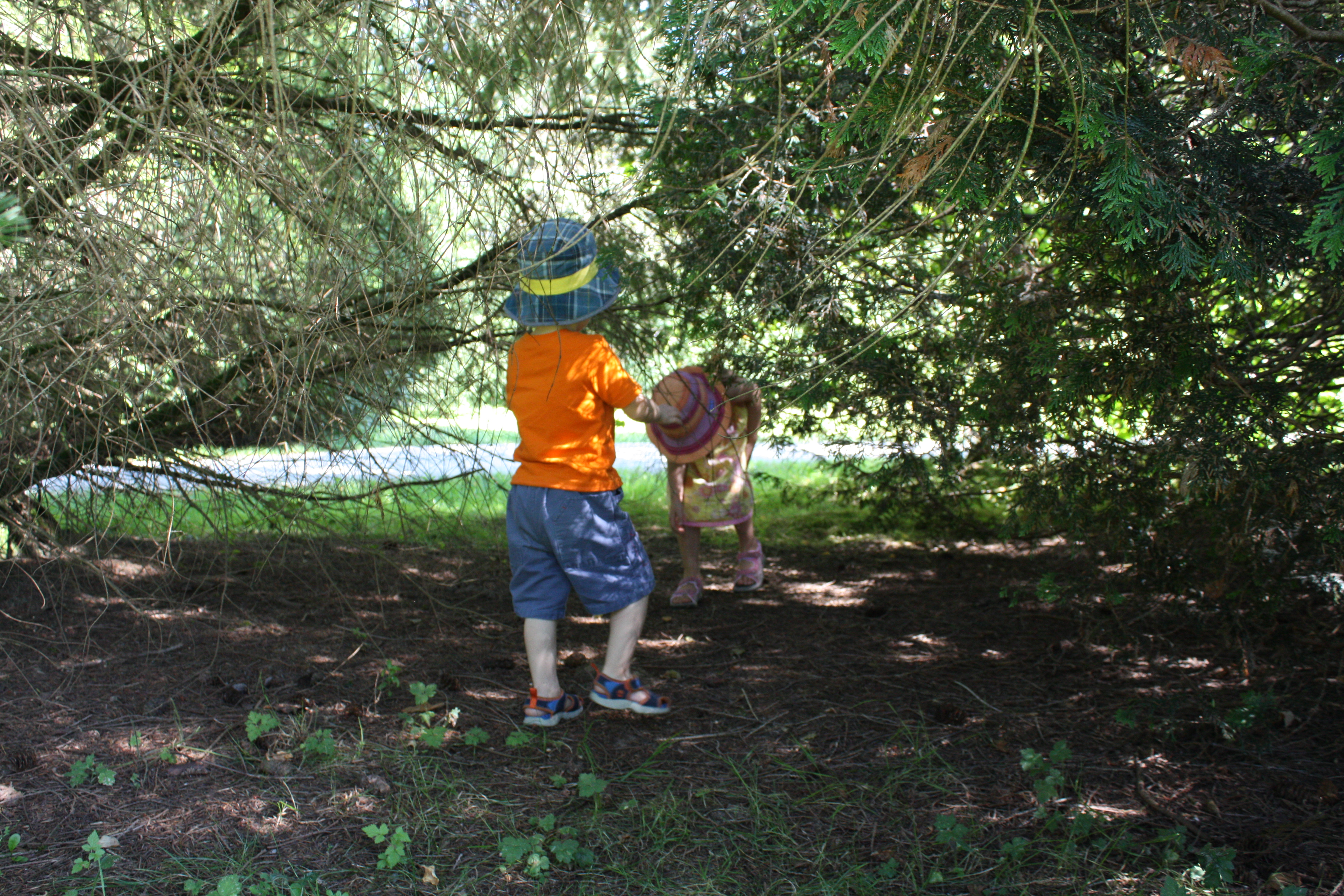
Alice and Isaac in nature

Alice, a neighbour’s 6 year old daughter, is learning how to read. She’s learning how squiggles on a page can be filled with meaning. She’s learning that these squiggles ‘say’ things. A whole new world is opening up for her, a world of different spaces and places she can travel to through those squiggles.

But I wonder what other kinds of reading she will need to master in order to make sense of the world in this age of climate change?  Should she know how to ‘read’ the land as her ancestors used to do?  To know what to expect when certain flowers are in bud or when the wind shifts or when particular birds arrive in the garden?

David Suzuki seems to think so. In a recent column he makes the case that children should learn how to observe the natural world. What he calls “observe” others like David Orr and Fritjof Capra call ecological literacy, a way of observation that decodes signs in nature in the same way that we decode squiggles on the page in traditional literacy.

If children learned to read their environment, what changes could we expect in society as they grew up?

One change perhaps would be the eradication of what Richard Louv calls nature deficit disorder, a result of children spending less time outdoors and too much time indoors, cut off from the natural world.

Each year when I take my  teen students on field trips into natural spaces, I am amazed at the transformation that happens when they spend time among the trees or just skipping stones on the water. It’s as though they have just woken from a deep sleep and are seeing the world anew. In effect, they probably are, given the amount of time they spend staring at screens instead of their immediate environments.

If children learned to  read their environment, they would have first hand experiences of changes wrought by climate change, experiences and knowledge that could not be ‘spun’ by the fossil fuel industry that spends billions each year fuelling climate change denial.

Environmentalist often lament the fact that our children can recognize more brand logos than they can tree leaves. Ecologically literate children would not only be able to name trees and describe their leaves but would also be able to name the kinds of fauna that depend on the tree for survival.

An ecologically literate child would know that she was not in the environment, that the environment was inside her.

An ecologically literate child would know that some forest bathing would do more for her stress level than retail therapy would.

An ecologically literate child would know the connectedness of all things, that whatever we do to the earth, we do to ourselves.

The scientific revolution gave us new tools to read the world beyond the visible light section of the electromagnetic spectrum. Before that dramatic change in the way we saw the world,  we had to know how to read the land for our own survival and so paid close attention to every detail of the natural environment.  These days we would sooner check the Weather Network online on our computers before we went outside to see what the weather was.

Before the scientific revolution, we would know when seasons changed when we saw signs of the coming change in trees, in plants, in the sky. Now we look at a calendar.

If we could integrate the kind of knowledge humans had about the natural world before, with the knowledge that we have gained through math and science, how much more could we read and see and know about this place, our cosmic home?

In an age of climate change, when all around us nature is signalling her distress, perhaps one of the most critical skills we all can have is the ability to read our environment,  the ability to read the sky, the land, the water, the plants and the trees.

We can’t all have the knowledge that the scientists on the UN Intergovernmental Panel on Climate Change do, but we all can know a little more than we currently do about what is normal and what is not in the natural world around us.

We should all join Alice in learning how to read, ecologically.

Costs and Benefits…

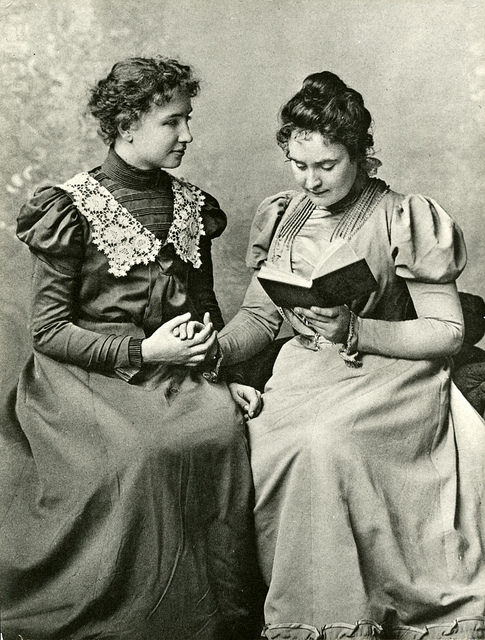
helen and anne s 2
Helen Keller and Anne Sullivan

Did you know that the BC government now considers learning supports for students with special needs in public education a “wage benefit” for teachers that is “too expensive” for taxpayers to afford?

Better read that again… I know it’s a bit of a mindtwist.  It would make sense though if you remember that this is the same group of people who have redefined what “essential” means… but I digress.

Back to benefits. Now you and I may expect employee benefits to be about medical coverage or a dental plan or a car or travel expenses. We’d be wrong, according to Premier Christy Clark. Benefits now include having other workers around you to do the work that must be done. By this definition, a nurse is a salary benefit to a doctor; a secretary is a salary benefit to an executive, and a dental assistant is a salary benefit to a dentist.

So, according this framing of our proposals for a wage increase in an attempt to decrease the blow our salaries have taken over the past 8 years due to the increase in the cost of living, if an Education Assistant helps a student in our classrooms, or if our school has learning specialist teachers, their work in the school is costed as a benefit to our salaries.

I wonder if the Premier counts the cost of her assistants in the same way, or are they just considered the perks of the job like dining out and iTunes purchases?

But what if we looked at the whole concept of benefits in a different way. Who actually benefits when we support students whose brains work differently?

We all do…

In fact people who ‘think differently’ have completely changed the world in the past. They are also presently changing the world and, if we give the students in our classrooms now the support they need, they will change the world of the future.

Take Michael Faraday for example. As a child he stuttered and struggled in school at a time when the very concept of support for students with special needs was unheard of. Luckily for us, his mother took him out of school and provided what she could in spite of their poverty.  When he grew up, even with an incomplete formal education, he discovered electromagnetism.

Now I’m not a scientist, but this much I know thanks to the television series “Cosmos”, that without Faraday’s discovery the very act of reading this blog post via the internet would not be possible.

Just sit with that fact for a moment…

Imagine what more Faraday might have given us if he had had support at school?

Here’s another example.  I’d never heard of Dean Kamen, the inventor of the iBot wheelchair and the Segway, before I watched an interview with him.  In it he explained how he struggled in school because, he said, as soon as the teacher opened her mouth he felt like a fire hose was coming at him. His  mind would be still processing the first thing the teacher said while she kept moving on, and he felt flooded with information. I imagine that this is how the mind of an incredible inventor works – taking a tiny bit of information and seeing infinite possibilities.

Thomas Edison’s inventions provide another example of how much we have gained from creative thinkers. The way Edison learned in school was so different to what other students did that his teacher said his mind was “addled”.  Despite only three months of formal schooling, he gave us the light bulb, the phonograph and the moving picture camera.  All inventions that radically changed the world.

We are very lucky when people who think differently have mentors or people who support them.   How much poorer in ideas would our world have been without the mind of Helen Keller, who although deaf and blind contributed so much through her writing and talks.  Her success due in no small way to the support she received from her teacher, Anne Sullivan.

Temple Grandin is another example of someone who has contributed much to the world after having lots of support as a child for her autism and speech difficulties.  What she has done is so amazing, Hollywood made a movie of her life. In fact Hollywood seems to have more interest than politicians do in special thinkers, given movies such as Radio,  A Beautiful Mind, Little Man Tate, Rain Man….

In this century, when all our chickens are coming home to roost in the form of dramatic climate change sparking the rapid spread of diseases once limited to small areas of the planet, we are going to need out-of-the-box kinds of  thinking that students with special needs do naturally all the time.  We are going to need special solutions to the special challenges we all face. Students with special needs may grow up to be the very people who will help us solve our most intractable problems.

So I guess in some sense, the BC government is right when they say that support for students with special needs is a benefit.

The part they got wrong however is that it’s a benefit for us all, not just to teachers. Supporting students with special needs will benefit humankind in ways we can’t even imagine yet.

But what about the costs if we don’t support these students? Well, apart from never knowing what the inventions or discoveries of students with special needs could have been, we will also continue to spend billions of dollars on a population of incarcerated people, many of whom are illiterate or have learning disabilities.

Since 2002  the number of Learning Specialists in BC schools has been cut by 20% and the cuts will increase again in 2014/15, a direct result of chronic underfunding. I’m not sure how much our Premier believes she is saving and for what purpose when she continues to cut approximately $250 million per year from the education budget, but that money is not really a savings if it has to be spent dealing with the costs of the consequences of those cuts.

Supporting all our students in all ways possible is not a cost when seen in this light. It’s an investment in benefits that we will all share.

Dear Christy…

door into school

Dear Christy,

It must be so difficult being Premier of the province these days. What with having to deal with all the complaints about  oil sands pipelines, and worrying about the changes in the LNG market, putting all your plans for our economy in jeopardy.  It must give you many headaches to have to think about all that.

I can imagine also that you must be very busy and hardly getting any sleep as you fly around the province to the various fundraisers for your 2017 re-election campaign. It can never be too early to work on the next election campaign, can it?

But what I wanted to write to you about was this fight you’re having with the teachers and the BCTF.  See, I’m not a politician but you may want to re-think your strategy with the teachers. Something happened when you locked them out of their classrooms in June….

Usually during lunch time they are too busy photocopying and working with kids and they don’t have much time to talk to each other but when the lockout forced them to eat their lunch out on the sidewalk, they suddenly discovered that they had lots of time on their hands and that they could have conversations in a way that is not possible in a busy school day or even on a Pro-D or in a staff meeting.

You see, normally in a typical secondary school that has a teaching staff of about 80 teachers, most teachers only ever talk to about 5 teachers daily and then perhaps about 10 others on other occasions but during the lockout, that changed. There was lots more conversation and, I’m sorry to say, those conversations were mostly about you and what your real agenda is when it comes to public education. Teachers shared information and experiences and built up relationships that had not existed before.

The other thing the lockout did was that it freed up time on weekends that would normally be used for marking and preparation of lessons but because you forbad teachers from doing any of that, they found it very difficult to break old habits.  They were so used to the kinds of tasks they had done for years on weekends, they looked for outlets for all that pent-up energy and that’s how they discovered social media in a way that was unprecedented.

They started pages on Facebook, they joined pages on Facebook and they set up blogs and wrote and blogged and tweeted.  They wrote letters to the media, they wrote letters to MLA’s. They commented on each other’s posts on the various pages set up to support teachers. They shared blog posts so much, they were noticed by alternative media like Huffington Post and Rabble.ca. They started Twitter tags   like #thisismystrikepay that went viral across the world.  Bit by bit they built up this network of connections and information that is proving to be quite resilient and resistant to anything that BCPSEA says or does.

I’m afraid that your lockout, the one they tagged #Christyclarkslockout on Twitter, has been the catalyst for the creation of a network focused on resisting any attempts to privatize public education in BC. 

I’m sorry to have to tell you this but all the work you’ve been doing for the past 12 years to save taxpayers money by shifting money away from the education budget and toward other investments may be all for nought as this network continues to grow and strengthen.

You should see what they’re talking about on all the pages! They’ve dug up all kinds of facts and statistics and information that makes a compelling case for their assertion that a well-funded public education system is critical to a democracy.  They are now also attacking your economic policies and are referring to studies that show that government austerity measures actually kill economies. This is dangerous information when you’ve been trying so hard to focus on balancing the budget. Do you know that they have the audacity to suggest that the whole concept of a balanced budget is just a myth and that there is enough money for schools if there is enough money for investments in mills and pipelines?

I think the best thing for you to do is to get teachers back into classrooms as soon as possible. Start the year early to make up for all the time that was lost in June!  Get teachers busy with lesson preparation and teaching again so that they can stop talking to each other and to the public about public education.  It’s actually quite scary the number of parents that are now talking to teachers!

Some of these parents are really very angry that they are only now realizing what has been happening in schools for the past 12 years!  They have been talking about working on a recall campaign and they have started so many petitions!

Oh! I should not leave out the students! Have you seen the letters they’ve been writing in support of teachers? And all those videos on YouTube? Some of them are quite clever and funny. Sorry, but they are! And they’re getting lots of views too!

So you see, if you get teachers back into classrooms you may be able to  stop this network  from growing and getting stronger.

I don’t want to tell you how to do your job, I know it must be quite stressful, but I really do think that you poked a hornets’ nest when you attacked public school teachers and their union.

To save yourself and your party’s chances for re-election,  you should do whatever it takes to get those hornets back into the nest. Give them whatever they say they need for their working conditions because you know they’ve argued quite successfully that their working conditions are students’ learning conditions and now parents agree with them. I don’t think you’d want to have thousands of parents angry with you when you promised to put their families first during your last election campaign. Best to do what you promised last time before you work on your promises for 2017.

I hope this helps and that you have a good rest before your next fundraiser!

Sincerely,

Joan Swift

We know you can help

lifesaver

I cannot believe that everyone who voted for  Premier Christy Clark completely supports what she is doing to public education in British Columbia.

I cannot believe that there are no people of integrity and ethics within the BC Liberal party.

I cannot believe that all BC Liberals are ignorant followers of a leader whose views they do not question.

I cannot believe that all BC Liberals think it’s a good idea to consult with a corporation, Cisco Systems, instead of professional teachers, about what is best for children in schools.

But…

I can believe is that there are BC Liberals who are economic conservatives but social progressives, people who believe in the importance of access to a good public education as critical to the strength of a democracy.

I can believe that there are many BC Liberals who have had teachers in their lives who made a significant positive contribution to the adults they became.

I can imagine that there are BC Liberals who are wondering how they can support teachers without leaving their political party.

In any fight for social or economic justice, it is those on the “inside” who can make a huge difference when they reach out to those on the “other side”.

In South Africa it was White people who worked with other White people and also with Black people who were critical to ending Apartheid.

It is men who talk to other men who can end the scourge of violence against women.

In Rwanda it is the Hutu women working together with Tutsi women who are continuing to rebuild their country.

Even in the world of finance, these conversations happen, as when billionaires not only tell other billionaires that massive economic inequality is not good for anyone, but who do something about bridging that gap.

Those kinds of conversations can happen here too. We would love to have conversations with people who voted for the BC Liberals in the last election but who are feeling squeamish and uncomfortable with what is happening in the courts, in our public schools.

We are appealing to BC Liberals of conscience, BC Liberals who walk with integrity, who uphold Canadian values of fairness and equity, to speak to your peers in the party. Speak to them about what you feel is at stake if public education continues to be underfunded and your leader continues her crash and burn attack on the BCTF that started 12 years ago.

Are you truly okay with school districts having to close school libraries? Are you okay with students in distress not having access to a counsellor? Is it fair that students who need support for their learning do not have a learning specialist teacher?

Is it what you wanted when you voted for your leader?

Do you really want a two-tier education system in the province where only those who can afford $18 000 per year tuition have access to small classes and full learning support? Can all BC Liberal supporters afford to put their children into private schools?

We know that you are shocked when you realize that a beginning teacher, after 5 years of post-secondary education, only makes $48 000 per year and that it takes that teacher 10 years to get to their maximum salary.

We understand why you would not have known this. Given what you are told on the news, it’s understandable that there are many aspects about the labour dispute with the teachers that you do not know about.

We understand that it is often confusing and frustrating to sort out the truth from all the rhetoric and posturing and sound bites. But we know that you have been trying to do that, to listen to teachers tell about their experiences in classrooms, how they can’t help all the students who need help.

We are asking you to help to ensure that all businesses, not just the LNG industry, have well-educated, skilled workers.

We are asking you to remember that the investment that pays the biggest longterm return for a company and for a country is the investment in the education of children.

We are asking you to do what you can to protect all that made us feel so proud to be Canadian two weeks ago on Canada Day.

We are asking you to help to keep our democracy strong, to keep Canada as a beacon of hope in the world.

We hope that you will help.

We know that you can.

Which side are you on?


I was not here in 1884 to protest our government’s banning of the Aboriginal potlatch ceremony which made criminals of people who were practicing an ancient culture.

I was not here in 1885 to protest the extortionate Chinese head tax aimed at reducing Chinese immigration to Canada.

I was not here in 1914 to protest when the ship, the Komagatu Maru, carrying 376 Asian immigrants was refused permission to dock in Vancouver because the exclusion laws of this land were “violated”.

I was not here to work alongside all the non-white women  who fought for decades, until the late 1940’s, for the right to vote after white women won that right in 1921.

I was not here in 1942 when Canadians of Japanese descent, had their homes and businesses expropriated and were interned in the country of their birth.

I was not part of many fights for civil and human rights here in Canada.

When teachers here first began to fight for more funding for public education in B.C.  in the 1980’s, I was living in South Africa. At the time the struggle against Apartheid had been ongoing for almost three decades.  People of my skin colour were born into the fight for democracy, for full citizenship.

At birth we were all “classified” into races. I was classified “coloured”. This meant that there was a limitation of my choices in life, but not as many as I would have experienced had I been classified ‘Native/Bantu’, a term used to refer to aboriginal Africans.

Politically, it meant that I could not vote, since only White people could vote in parliamentary elections.

Economically, it meant that I could only consider work and careers designated for me under laws that controlled access to employment for all ‘races’.

Socially, it meant that I could only visit certain beaches, attend certain cinemas, ride on certain buses, eat in certain restaurants, enter post offices at certain entrances and sit on certain park benches, inconveniences shared by all non-Whites.

Being born brown-skinned in a country whose government used the legislature to pass heinous laws that robbed people of basic human rights gave me a profound education in the use and abuse of political power.  My experiences in South Africa provided me with a particular political lens through which I view the actions of the B.C. Liberal government. So much of what is done in the legislature in Victoria seems familiar.   Politics here may not be as black and white as they were in South Africa but sometimes the laws that the BC Liberals pass  seem like just a different shade of grey  when compared to the laws passed in South Africa during Apartheid.

And so, at a time when all South Africans enjoy the rights of  full democratic citizenship, I find myself here, on the opposite side of the world, where democracy and civil rights are under attack.

I find myself here at a time when workers’ rights, won over many struggles over a century ago, are in danger.  I am here now, when the very concept of a free, equitable, public education system is being threatened.  I am here now, one of thousands, making history for the textbooks of tomorrow.

Students in the future will learn that a government in a democracy not only  attempted to disregard two Supreme Court rulings but also the highest law in the land, the Charter of Rights and Freedom. They will learn that over several decades, teachers in British Columbia fought to ensure there was a fully funded public education system. They will also learn of the particularly difficult fight that began in 2002 when the  government  attempted to eradicate the rights of teachers to negotiate the learning conditions of students and the working conditions of teachers.

In South Africa I did not have a choice about which side I would be on in the struggle for justice. That was determined at birth. But here,  in Canada, where all citizens in this province have a choice,  I will one day be proud to say that I was on the side that fought to save public education from attempts to gut it financially. I was on the side that fought to save one of the most important  pillars of democracy: an education system that provides for the needs of all citizens, not just those born into affluence.

Yes, when I look back on my life someday, I will be able to say,  I was also there then.