Celebrate the Elimination of Provincial Exams?

provincial exams

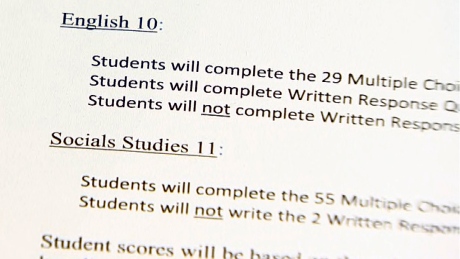
If I wasn’t so familiar with the Ministry of Education’s Jekyll-and-Hyde character, I’d be thrilled with the new Graduation Program. After decades of frustration about the limits to student learning experiences that provincial exams set, I’d love to pop a champagne cork now that I am free of the fetters they placed on my lessons.  

The announcement of the changes has revived old arguments about what exams are for.  I must say that I disagree with the learned professor who believes that the removal of exams will lead to the dumbing down of learning. I happen to agree with my students that they don’t need to know the details of the Halibut Treaty in order to fulfill their responsibilities as citizens in a democracy. Many of the arguments that Dr. Livingstone makes have been made throughout the history of education whenever changes have arisen.  Plato himself lamented the rise of writing in place of dialogue. That was over 2000 years ago.

After decades of  feeling like a quisling every time I told my students how “important” studying for provincial exams was, I’ll happily let them know that they no longer will have to spend months memorizing the gajillion facts that they can instantaneously access on their personal devices.

But my joyful relating of this good news will be dampened by the knowledge that there is no funding to make possible the full implementation of the new curriculum.  It’s as though my students have been given the keys to a car without any money for insurance or gas or maintenance or even driving lessons.

The new curriculum requires more student-led activities but when schools are at or above 200% capacity where will teachers find the space for breakout rooms so that small groups of students can work together on projects?

Personalized learning is one of the core ideas in the new curriculum but with no Education Assistant support for students with special needs, how can one teacher provide personalized learning for all students in a class of 30?

Given the pattern of cuts that the Ministry has imposed on school district budgets, I suspect the elimination of some provincial exams is more of a political rather than a pedagogical decision. If it were purely pedagogical, the FSAs would be eliminated as well.

Contrary to what the Minister says about them being “valuable” FSAs only serve to highlight the socio-economic differences between schools. Unless and until the Minister is going to do something to alleviate those differences, they only serve to support the arguments of those promoting the growth of private schools.

After 15 years experiencing the BC Liberals’ brand of public education, I have a lot of difficulty believing that the Ministry makes any pedagogically-based decisions. Take a look at the mandate letter that Mike Bernier received from Christy Clark upon his appointment as Minister. His top task is to balance the ministerial budget. His final task (on a list of 13 items)  is to ensure that “taxpayer resources” are used “efficiently. Nowhere in his mandate letter is there any acknowledgement of barriers to learning such as a 20% childhood poverty rate in this province.

The provincial exams were indeed a barrier to my students’ pursuit of learning and I am pleased to see them gone. Each year my students take on the role of adult citizens when our classroom becomes a country. Through the process of electing a government and participating in an economy, they become curious about many things that will never be on the Socials 11 provincial exam: mercantilism, Machiavelli, Kant’s Categorical Imperative, egalitarianism, ethics. 

In the past I’ve only had enough time to guide them through brief glimpses of these and many other concepts so they have often been frustrated when discussions had to be stopped because we had to study the Statute of Westminster instead.

I am relieved that I will now be able to assess and evaluate my students in ways that fit their learning experiences. Perhaps that’s enough of a reason to celebrate the new Graduation Program. Perhaps.

B.C. Public School Supply List: Fall 2016

asbestos

For Immediate Release

Lower Mainland, BC

22 May 2016

PARENTS PREPARE TO PURCHASE ADDITIONAL SCHOOL SUPPLIES

Given the current state of many public schools in this province, and in light of the inadequate response by Premier Christy Clark’s government, parents of students in school districts with funding cuts are advised to prepare for increased spending on back-to-school supplies in Fall 2016.

School supply costs have been rising recently as BC Liberal government cuts to school district funds have resulted in fewer resources for classrooms. While teachers spend an average of $1200 per year on their classrooms, parents have been spending an average of $108 per child on traditional school supplies as well as about $150 on fundraisers throughout each school year.

This year however, parents are advised to budget  for additional expenses in the new school year to ensure their children’s safety while at school:

Suggested School Safety Supply List

  1. Water testing kit to check if your child’s school is one of the 92% likely to have lead in drinking water
  2. Hazmat suit to protect against asbestos contamination
  3. Reflective vests for long walks to school in the absence of schools buses or public transport
  4. Mask to protect against breathing in mould spores
  5. Mice/Rat traps (humane ones)
  6. Buckets to catch water falling through leaky roofs
  7. Personal fans/heaters to keep cool/warm in schools with aging heating/cooling systems
  8. Safety whistle to blow after earthquake so that recovery crews can locate survivors

“It’s scary how dangerous attending school in this province has become,” said Sue Parent. She went on to say that school used to be a safe place for children but for the past 15 years, she’s noticed that parents have become increasingly concerned about the BC Liberal government’s dereliction of duty regarding the health and safety of children in public schools.

Jane Parenting commented that when she went to school in the 1980s the only items her parents had to purchase were pencil crayons and a geometry set. She is alarmed at the changes in school supply lists that she’s seen over the past two decades.“When we were asked to supply photocopy paper that was bad enough but now the needs are simply shocking. One would think that it was the Ministry of Education’s duty to ensure that schools were free from mould, leaks and vermin,” said Jane. “I’m stunned that the Ministry does not seem to see that.”

Joe Taxpayer-Parent added that because parents were legally obliged to ensure the well-being of their children, they felt it necessary to purchase additional school supplies.

Ends

410 words

Contact

Bee Cee Voters

bcvote@bccitizen.com

123 Fiduciary Duty Avenue

Victoria, B.C

Privatizing Public Education, part two

private public park

As a technology corporation you have long been aware of Rupert Murdoch’s suggestion to invest in the education sector that is worth trillions of dollars. Unfortunately, as you are also aware, investment in this sector is particularly tricky and requires much patience.

By following the previous suggestions on how to lay the groundwork for investment, you will be ready for the implementation phase.  This phase too requires subtlety and a soft approach.

Priming

There are a few ways you can prime parents and the public into accepting privatization in schools.  One way is for corporations to provide resources either in the form of textbooks and other learning materials or in the form of cash that students and their parents earn when they purchase particular products.  Chevron’s Fuel your School is an excellent example of the latter.

Another way is to have teacher-run cafeterias replaced by those run by corporations such as Chartwells,  although profit is not always assured as was the case in New Brunswick.

A third way is to encourage corporations to support charitable handouts to schools as in the case of Postmedia’s Adopt-a-School program.

Of course vending machines in schools have long been a source of revenue for both the corporation and the school, and provide a good example of the kind of private-public partnership you want to encourage.

Framing

It’s necessary to have a public relations firm work with the politicians you are funding to ensure that they use language that frames the discussion of public education in a way that is favourable to the privatization project.

When your politician reduces the education budget, it’s important that she refer to members of the public as taxpayers.  Her message should be that she is concerned about taxpayer resources, that she wants to ensure that taxpayer money is not wasted.

However, in the event that the teacher union engages in strike action to force a settlement of their working conditions, it’s critically important that your politician speak of her concern for the inconveniences suffered by parents when schools are closed.

Budgeting

It’s useful to have your politicians enshrine balanced budgets into law.  The general public is law-abiding and intolerant of those who break the law. This is helpful when a rebellious group of school board trustees refuses to submit a balanced budget.  A media campaign that frames them as lawbreakers will distract the public from funding cuts.

Because all households are aware of the need to balance their budgets, it’s easy to convince the public that school districts need to do this as well.  Your politician should  be seen to be acting on behalf of the taxpayer and protecting their “resources” when she insists on a balanced budget.

Dividing

One can’t stress enough the necessity to ensure that groups of parents and teachers do not join forces.  This is why it’s critical that school rankings such as those provided by the Fraser Institute are vigorously defended. It’s unfortunate that in BC a school in Bountiful, where polygamy is practiced, was ranked highly when schools that provide breakfast programs and other social supports for students were not.

When the rankings get a lot of attention in the media, they are legitimized. Another benefit is that there is a spotlight focused on schools that are “failing” to meet the needs of students.  With the right media in place, this failure will be seen to be the fault of teachers and school boards.

Remember that the foundation of all business models is the provision of a service. It’s in the best interests of corporations that schools are seen to be failing. After all this was the reason given by Milton Friedman himself when he promoted the privatization of schools as a way to save public education.

Cautionary Note

You may encounter criticisms of your privatization project especially from those members of the public familiar with the failures of privatization in places such as Chile and in many parts of the United States.  The good news is that by the time the public cottons on to the flaws of privatization, your corporation will have already benefitted from government contracts and can then move on to new projects in other parts of the world.

Word is that Africa may be ripe for reaping should projects in North America fail.

Softly Selling the Privatization of Public Education

May be an illustration of text

When there’s news every day of yet another school district budget shortfall and yet another school being closed, it’s difficult to see what’s really been happening to public education in British Columbia for almost two decades now. But within the seeming chaos there is a clear pattern that emerges. It’s a pattern that can be clearly seen in many countries around the world as corporations turn their profit-hungry eyes toward the $5.5 trillion that is being spent on education worldwide.

Over a century ago public education was a radical idea in Britain. It was considered an utter waste of taxpayer’s money and was strongly resisted by many politicians. Nevertheless, arguments about public education being a public good won the day.

The big idea was that public education would provide an equal playing field for all society’s children.  Children from poor homes could work their way up the social ladder through a free education and this in turn would ensure that the state would benefit from having a well-educated workforce and citizenry.  Sounds all very democratic, doesn’t it?

Fast forward to the 1970s and a new idea began to spread from a group of economists at the Chicago School of Economics. One of them, Milton Friedman, wrote a seminal paper suggesting that public education be privatized.  For most people in North America this was an outrageous idea akin to suggesting that we should sell motherhood.  Because of the strong resistance to privatization of public education, it has to be sold to the public in a way that is subtle, is soft, is slick.  

HOW TO PRIVATIZE A PUBLIC EDUCATION SYSTEM

You will need the help of politicians. This is easy to obtain since they are always looking for donations for their election campaigns. Spending a few million will reap rewards ten times over. Once you have politicians on board, direct them thus: 

Competition

Erode the collaborative and co-operative foundations of public education by introducing competition between schools. As an example, in B.C.  the Fraser Institute began to rank schools in 1998 in a way that completely ignored multiple variables that made each school unique but that made sense to a public used to hockey team rankings.

Choice

Create a two-tier education system, one public and one private, both supported by public funds.  Keep increasing the amount of public funds that go to private schools while decreasing the funds that go to public schools. Watch while private schools advertise everything that public schools are accused of not having: small class sizes, new technology, support for students with learning disabilities.

Costs

Promote the idea that funding public education is too expensive and outside of the “affordability zone” for taxpayers. Keep changing the formula used to fund schools while you repeatedly tell the public that you’re increasing funding. They won’t realize that you’re spending less and less each year as you no longer fund things you used to fund in the past.

Count 

Insist that public schools be accountable. Insist that students be subjected to standardized tests like the FSA so that taxpayers can see whether they’re getting what they pay for. Ignore all the protests about standardized tests being invalid and that they don’t reveal anything of value regarding a student’s learning experiences.

Create Divisions

Implementing these steps needs to happen over a long period so that the pattern is not too obvious.  While you are waiting for the public to accept that privatization is good and is inevitable, it is also important to ensure that groups that may be natural allies, do not unite. It is therefore necessary to divide parents from teachers.  Use every opportunity to increase any dissension that may arise.

For example, when Parent Teacher Associations in BC were replaced by Parent Advisory Councils, teachers and parents moved to separate camps, so to speak, and this was good for the privatization agenda.  When the provincial body of PACs, the BCCPAC,  was led by those in support of accountability, this was also good for the privatization agenda since the perception was that the parents of 500 000 students were in support of the BC Liberal government’s education policies.

Speaking of perceptions, another important project is to change public perception of teachers.  There should be no limit on the budget spent on public relations in this regard. Painting teachers as greedy and lazy will turn public sentiment against them.

Also, support and encourage attacks on the teachers’ union. In BC, the attacks on the British Columbia Teachers Federation took the form of newspaper articles and editorials and also social media comments made by  digital influencers.  

You should also try to weaken teacher unions by other means. For example,  court cases that take over a decade to resolve.

Be Patient

Finally, patience is required for the privatization project since most people in society value public education and strongly believe that it’s a public good.

It’s the soft sell that will win them over.

Remember there is a big reward: a piece of that $5.5 Trillion pie.

Open Letter to Oklahoma Voters and Lawmakers

Given the current government’s gouging of public education funding, in one of the richest provinces in one of the richest countries in the world, there will be many more teachers here in BC writing letters like this soon enough.

Steven E. Wedel's avatarSteven E. Wedel

I am a teacher. I teach English at the high school of an independent district within Oklahoma City. I love my job. I love your kids. I call them my kids. I keep blankets in my room for when they’re cold. I feed them peanut butter crackers, beef jerky, or Pop Tarts when Michelle Obama’s school breakfast or lunch isn’t enough to fill their bellies. I comfort them when they cry and I praise them when they do well and always I try to make them believe that they are somebody with unlimited potential no matter what they go home to when they leave me.

What do they go home to? Sometimes when they get sick at school they can’t go home because you and the person you’re currently shacking up with are too stoned to figure out it’s your phone ringing. Sometimes they go home to parents who don’t…

View original post 1,104 more words

Changing Schools from the Inside Out

A year ago this month, based on the international popularity of a blog I had written for Huffington Post,  I was invited to speak at two conferences in Italy. And so it was that in October 2015 I travelled to Europe and presented my teaching ideas in Milan,  in Ferrara and in Florence. The above video was filmed in Ferrara and in Florence.

Sharing my ideas in Italy was quite a surreal experience because I had held these ideas for most of the three decades of my teaching career but had always encountered massive resistance to them from colleagues and from superiors whether in South Africa or in Canada.

But something has shifted within the education system and so what was considered too radical years ago is now being welcomed as a great new idea: that classrooms should be spaces that students find socially inviting, emotionally safe, and intellectually stimulating.

This coming summer I’ll be sharing these ‘radical’  ideas during a three-week course I’ll be teaching at the University of the Fraser Valley as part of their Teacher Education Program.  The course, Changing Schools From the Inside Out will explore spaces where change is possible despite restraints within the education system.

A few of the practices I use in my high school classroom will be embedded into the course: journalling, movement, meditation, and laughter.

The three hour class each day will be divided into time to share within the circle, time to listen to a lecture, and time to practice and/or explore new ideas.  Gather, Think and Do, respectively.

I am very excited about this opportunity to teach and to learn with other teachers and am looking forward to showing what I’ve learned through “chart and chance” over my career.  As Ken Robinson has said:

Opportunities for change exist within every school, even where the emphasis on high-stakes testing has become extreme. Schools often do things simply because they’ve always done them. The culture of any given school includes habits and systems that the people in it act out every day. Many of these habits are voluntary rather than mandated – teaching by age groups, for example, or making every period the same length, using bells to signal the beginning and end of periods, having all of the students facing the same direction with the teacher in the front of the room, teaching math only in math class and history in history class, and so on. Many schools, a good number of which are dealing with adverse conditions and were once considered trouble, have used that space to innovate within the system, often with inspiring results. Innovation is possible because of the sort of system that education actually is. ~~~ Ken Robinson in Creative Schools.


Dear Teens

http://publicdomainarchive.com/public-domain-images-woman-earth-globe-white-short-outdoors-water-reflection/
http://bit.ly/1KAzfNf

I see what you’ve been doing. I’ve been noticing it for a while now. Almost weekly you are solving intractable problems that have had adults stymied for years. A cheap way to check for pancreatic cancer. Stopping the spread of germs on planes. Cutlery that scans for bacteria.  A rain and fireproof sleeping bag for the homeless. The list gets longer each time I look.

And what amazes me is that even when you don’t have many resources, you’re re-inventing the world. You’re doing it with scraps from dump heaps and in places where there are few books and only occasional electricity.

I’m envious. You’re just newly arrived here on this planet and yet you seem to see much more than we who have been here for many decades. Perhaps we have become jaded or too resigned to the world we know?

Of course it helps that you don’t have to invent mathematics. Or the printing press. Or the Internet.  With easy access to the collective pantry of human ideas, you are deftly repurposing and reconfiguring what you find here.

And you do this despite what you learned in kindergarten, one of the first lessons in school: stay inside the lines. Luckily for us, you realize that colouring outside the lines can create a completely different picture. It’s outside conventional lines of thought that creative solutions lie. As you are well aware, it’s outside we’ll all have to go if we have any hope of leaving a livable planet for your children.

You’re quite concerned about the state of the planet you find yourself on and so apart from all the scientific breakthroughs you’re making, you’re also stirring change socially and politically in ways that sometimes stuns.

Those of us who are watching you know that Malala Yousafzi is not an anomaly, that there are many like her who refuse to accept the norm as normal for young women.  We know not all 12-year-olds can start an organization like Free the Children but there are many more like Craig Kielburger who want to end social iniquities such as child slavery. We know that First Nations youth are “idle no more” despite their inheritance of a painful legacy. And we know that Victoria Barrett, who is suing the Obama administration, is at the vanguard of youth demanding that something be done to mitigate climate change.

There are multitudes of you with many brilliant ideas but too often those ideas are being buried beneath your boredom and frustration in schools. It was no surprise to see in a recent study by Yale that 75% of you are either bored or frustrated or tired in schools.  It’s certainly no surprise to Sir Ken Robinson who has for decades been urging schools to allow you to be who you are: creative problem solvers.

But despite his message resonating with teachers worldwide, too many politicians insist that you become human calculators, writers of the 5-paragraph essay and memorizers of the information you can access within nanoseconds on that device in your pocket.

It’s no wonder that many of you are tired. I would be exhausted every day if I had to adjust and adapt to a new environment every hour as you do in schools. How do you cope with being in Biology for an hour and then completely changing your train of thought to adapt to French or Physics in the next hour? How do you adjust to the emotional climate of so many different classrooms and teachers each day? The effort must be daunting!

I wish that schools nurtured your creativity instead of punishing it.  I wish that you were given time each day to allow your ideas to gestate. And I fervently wish that public schools were funded as a priority so that you had all the tools you needed to show us what we cannot see.

If these wishes came true for all of you and not just a few, I can’t imagine what you could do.

But I bet you can.

In admiration,

A Teacher

Take the Leap

leap

She had tears in her eyes when she said, “I wish I could teach like you do but I’m too afraid”.

I didn’t know what to say and mumbled something that probably did nothing to assuage her grief as I hugged her.  I’d like to try to say something in response now.

On the long road that led to being invited to Italy to share my teaching ideas, I too shed many tears. I know very well what it feels like to be overwhelmed by the enormity of our task and the impossibility of ever doing enough for every student in our classrooms. And I too have an abject fear of failure.

But what I hold on to when I take that leap into the unknown every time I try something new in my classroom, is my extreme distress at the discomfort so many of my students experience in school,  and my ongoing irritation at the waste of their creativity.

Have you noticed lately how often there is news of yet another discovery or invention by a teenager? How many more could there be if we could stop force-feeding them boredom and instead unleashed their minds to look anew at the intractable problems of our world?

I wonder how many teachers, after hearing Ken Robinson’s plea for us to nurture creativity in schools, take the leap into innovating their teaching practice? Since February 2006 the talk has been viewed over 36 million times and translated into 59 languages but I’m curious about what its impact has been on the critical core of education systems: the relationship between teachers and students.

That’s where the “frontlines” of innovation actually are: the space between a student and a teacher. It’s what I find in this space that motivates me to keep trying to change what happens in schools.

In that space hangs the question each student asks of me: Do you care?

It doesn’t matter if you’re a taskmaster or a laissez faire teacher, a charismatic John Keating (Dead Poet’s Society) or a demanding Jaime Escalante (Stand and Deliver),  caring comes in many colours in classrooms.  And, luckily,  students are caring colourblind – they’ll take any colour of caring that they can get.

They really don’t need all the technological tinsel promoted during too many professional development workshops. They may enjoy the novelty of it but when that wears off, they’re back to wondering whether you, their teacher, care.

Care is one of those words that can have many interpretations but what I mean does not include unicorns and rainbows.

Caring is pragmatic. Even if I can’t change the entire system today, every day I can ensure that my students, in my classroom, are as comfortable as possible by allowing them to move, to eat, to take brain breaks. I can choose to be aware of what they need as human beings, not as empty vessels to be filled and tested.

Caring is challenging. It requires me to put myself in another’s shoes, to be compassionate, empathic; to see the other, my student, as I would want to be seen. Even when, and especially when, that student is recalcitrant.

Difficult students have been my most memorable teachers because conflicts with them have been the catalyst for my excavation of who I am as a teacher.

This excavation is necessary because it’s where all change, anywhere, begins. From the inside out.

So if we are to change education systems, yes, it’s important that there is political and economic support for change, that there is social support for innovation, and that enough time is also provided for teachers to explore new ideas, but what is most critical of all is that each individual teacher gather up enough courage to override her fears about changing what she does each day in her classroom.

Because change requires courage.

The kind of courage that Brene Brown talks about in another famous TED talk. The kind of courage that requires the willingness to be vulnerable, to risk being hurt.

The kind of courage lubricated by tears.

And, dear colleague, when you’re ready to take that courageous leap, I’ll be there to hold your hand.

We’ll take that leap together.

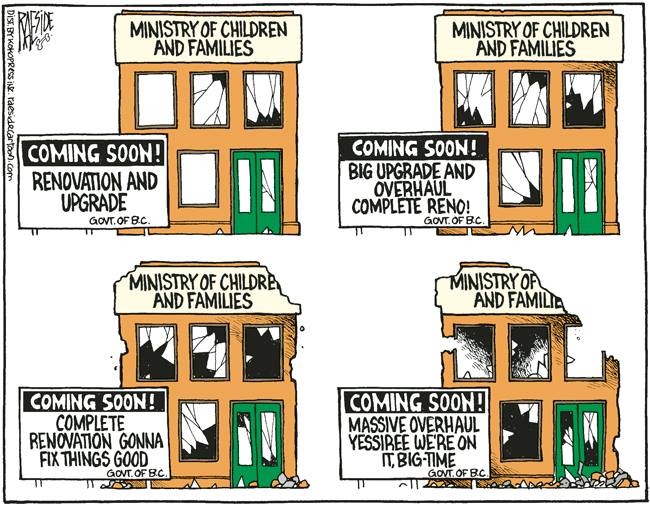
The children that Christy Clark forgot

broken ministry cartoon
Image courtesy Raeside cartoon.com

I’m thinking of the students who wish school was open today. The  ones whose only meal each day is the one they get through a school meal program.

I’m thinking of the one in five B.C. children living in poverty who Santa Claus will forget. The ones for whom Friday will be just another hungry day in one of the most affluent places on earth.

I’m thinking of the mother who works at least two jobs and yet still can’t provide more than the bare necessities for her children.

I’m thinking all this while a vivid childhood memory whirls in my head of my mother singing Nat King Cole’s The Little Boy that Santa Claus forgot:

He’s the little boy that Santa Claus forgot

And goodness knows, he didn’t want a lot

He sent a note to Santa

For some soldiers and a drum

It broke his little heart

When he found Santa hadn’t come

In the street, he envies all those lucky boys

Then wanders home to last year’s broken toys

I’m so sorry for that laddie, he hasn’t got a daddy

The little boy that Santa Claus forgot

Premier Christy Clark is probably hoping that we have forgotten about her broken promises.  She won’t want us to remember what she said about putting “families first” in her last election campaign. Or how she offered parents $40 a day while she kept their children out of school in her attempt to get teachers to back down in their fight for more educational support for children.

What she fails to realize is that for thousands of children in this province, school is much more than a place they go to learn an approved curriculum.

They are the students who come early and leave late each day because school is where the peace and quiet is.

The students who count 24 hours between meals.

The students who teachers have in mind for every Adopt-a-School request for funds.

The students who are expert couch surfers, relying on the compassion of the parents of their school friends.

They certainly can’t rely on the compassion of a premier who spends thousands of dollars to take her son on a trip to the other side of the world so that he can learn empathy.

If we accept the view of honorary Canadian citizen, Nelson Rolihlahla Mandela, who said that “there could be no keener revelation of a society’s soul than the way it treats its children”, then what are we to say about the soul of the province of British Columbia  when news about yet another child dying while in the custody of the Ministry of Children and Families elicits nothing more than a shrug from the government?

During this Christmas season, when the birth of a child is celebrated with much largesse, I think about the children this government has conveniently forgotten.  

When the  BC Liberals, in their bid for re-election in 2017, spin all the facts of their malfeasance, when they whitewash the 15 years of cuts they have made to services for children,  I hope that voters will remember the children that Christy Clark forgot.

Lazy Teaching

lazy teaching
http://www.imcreator.com/free/education/phone-home


I was accused of lazy teaching this week. The accusation came along with an outburst of frustration from some students after I had suggested that I would send a video link in response to a Question Box question: 


[When] you said “I will send you a video on this question” I wanted to scream. I look forward to Question Box because that’s when you talk to us and explain so thoroughly and it’s like a rollercoaster. You take us to places where our brains would never have gone on their own. You explain to us with emotion, something a random guy on the Internet cannot do. When you show us videos you take the lazy way out.

Any teacher is capable of sending a link of a video or giving us something from the textbook but if you are capable of actually explaining (which you are) then do it!

I don’t even understand anything a guy is saying in a video cause they talk fast and just say useless facts but you don’t. You explain, you connect.

I always talk about you and have something to say but that won’t happen if you become an ordinary teacher. Don’t be lazy!

I hate videos because they don’t have the same impact as someone who actually talks and interacts with us. Also, you were basically giving us advice and I’d rather have advice from someone I know and have known a bit and understand rather than someone who doesn’t know me. I can’t take their advice seriously because they don’t know me and I don’t know them.


I wonder if the proponents of ‘personalized learning’ know this about the way students who are digital natives prefer to learn?