What should be included in Back to School Supplies?

back to school supplies

What kinds of conversations have you been hearing about back to school supplies lately? The angry ones where parents fume at teachers for demanding so much? Or the sad ones where parents living in poverty are trying to figure out what to cut from the household budget in order to buy a new pair of shoes for a child? Or have you heard those heartwarming stories of strangers approaching teachers in stores and offering to pay for all the classroom supplies that teachers are purchasing out of their own pockets?  

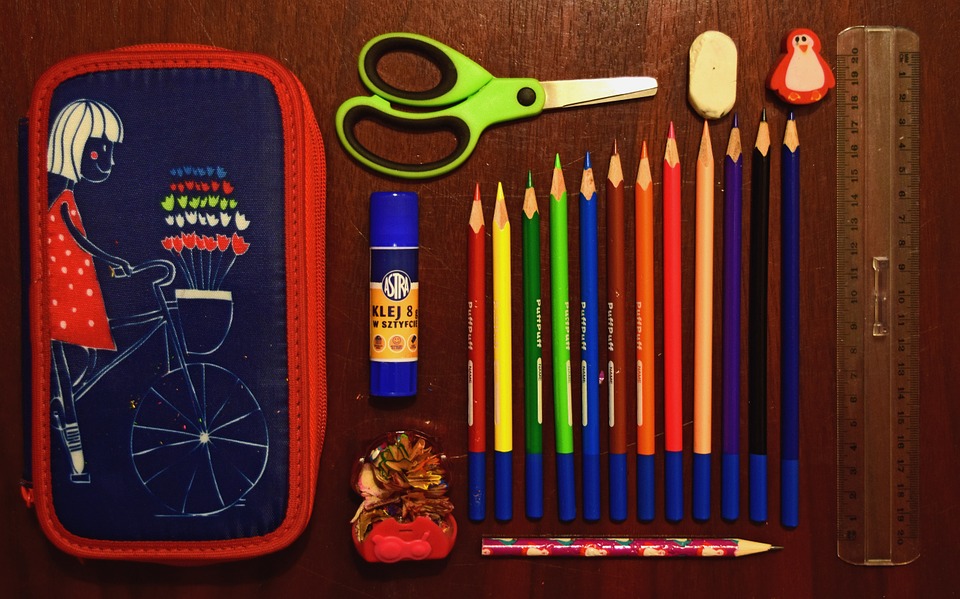
You must have noticed how these lists have been getting longer each year. You recall that thirty years ago, school supply lists were quite short, perhaps just two items: pencil crayons and a geometry set. But, for a number of years now,  the lists have become very long and often include two types of paper: photocopying and toilet.

How did we get to this point?

Increasingly longer school supply lists are now the norm everywhere public education is undergoing “reform”  but here in BC we can trace the pathway back to 2002 when the newly-elected BC Liberals changed the formula for funding schools. In essence this meant that they would no longer fund resources that previous governments had funded. And so, for the past 15 years, as costs have increased,  school districts have had to do more with less. They have long been cutting “low hanging fruit” and have reached a point where there is nothing more to cut. Now, parent-taxpayers, along with annually contributing to taxes earmarked for schools, have to make additional contributions to education resources.   

This is much easier for some parents to do than others.  For parents living in poverty, it is quite a hardship. With BC having the highest rate of childhood poverty in Canada, there are thousands of parents right now wondering which essential item in their household budget to do without so that their child will have shoes, clothing and supplies for school.

Whilst providing the basics may not be a difficulty for other parents, there are a different set of concerns that keep them awake at night: worrying about whether their children’s health and safety is assured while they’re at school.  15 years of cuts to education funding means that there are many public schools where parents are wondering about whether  to include the following on their shopping list for school supplies:

  1. A water testing kit to check if their child’s school is one of the 92% likely to have lead in drinking water
  2. A hazmat suit to protect against asbestos contamination
  3. Reflective vests for long walks to school in the absence of schools buses or public transport
  4. A mask to protect against breathing in mould spores
  5. Mice/Rat traps (humane ones)
  6. Buckets to catch water falling through leaky roofs
  7. Personal fans/heaters to keep cool/warm in schools with aging heating/cooling systems
  8. A Safety whistle to blow after earthquake so that recovery crews can locate survivors

Including these items on a school supplies list will add several hundred dollars to the average cost of $108 per child per year that parents spend. And that spending would be in addition to the $150 per child per year that parents are contributing to fundraisers.

Given that our Premier has already begun campaigning for re-election in 2017, perhaps conversations about school supply lists should be expanded to a province-wide conversation about how our public education system is funded.

How is it possible to have a “strong economy” when our schools are in such a state?

Whose tomorrow can be secure when our children have to contend with dilapidated buildings, overcrowded classrooms and a lack of support for their learning needs?

While considering who to vote for in May 2017, can we have a conversation about the value of public education to the citizens of BC?


Building Community With Attendance Questions

My blog published on Edutopia today…

iStock.com/monkeybusinessimages

Taking attendance shows which students are physically present, but asking an attendance question stretches students’ minds toward actively learning as part of a classroom community.

Source: Building Community With Attendance Questions

What to Teach in Times like These?

https://pixabay.com/en/hands-heart-love-bright-sun-697064/

I’ve been turning off the radio whenever the news comes on, having exhausted my capacity to consume any more details about the latest atrocity, whether it’s a 5-year-old girl being murdered along with her mother in Calgary, or a huge truck crushing people celebrating Bastille Day in Nice. I don’t even want to know what’s happening in Turkey, and I absolutely do not want to think about TrumPence in the US.  Yes, I am being selfish, trying to protect my heart from any more hurt and horror.

But I know that, as a teacher of teens, I can only have a temporary reprieve. Before September, I need to find some way of explaining it all.

And how in the world do I do that?

In our schools we offer students tidy packages of information in textbooks. The four reasons for WWII, the ‘correct’ interpretation of novels and Shakespearean plays.

In their exams they’re asked to regurgitate that information, with the highest awards going to those students who tell us exactly what we told them. We reward them for telling us what we already know: the answers to the questions in textbooks and tests.

But teenagers begin to realize that the answers they’ve been given do not explain the world as it is, and that realization leads to many questions, the kind that find their way into the Question Box in my classroom.

Although students can place anonymous questions about anything and everything into the box, the most common topic is conflict, from the personal to the political. They want to understand conflicts with parents, with siblings, and with friends. They also want to understand why humans resort to violence and aggression so frequently when there is conflict.

Essentially, my students want to know why it’s so hard for people to get along with other people.

In the past I’ve explained the psychological, sociological, cultural, political and evolutionary basis for human behaviour but, given recent events, I no longer believe that that’s enough.

Unlocking the World

As a teacher-host, tasked with what Claudia Ruitenberg calls “unlocking the world” for my students,  I feel as though they’ve been invited to a home that has been trashed by earlier guests. They have newly arrived in the world and are eager to learn about it, but what do I offer as explanation for the mayhem they see on their screens?

What does one teach in times like these?

A few months ago, after we’d had discussions on all the questions in the box,  one of my students asked: What are you adults not telling us?

The question stumped me. I had no answer then, but I think I do now:

We adults appear to be in charge, to be in control of what happens in the world, but we’re not.  We know the solutions to many social and political problems, but we don’t always act on them. And the reason we don’t is because we lack the courage to do so.

Courage

Courage is not something that students can learn about from textbooks. It’s not something that can be tested in exams. There are no cheat sheets or Spark notes for it.

Knowing how to solve a quadratic equation will not help to bridge the divide between the descendants of slave owners and the descendants of slaves.

Knowing how to parse a sentence will not help to tell the story you are too afraid to tell.

Knowing the causes of The Great War will not help you to act when you see someone being bullied.

Only courage can help you to do all these.

Teaching courage takes courage, I’ve discovered. The old adage that children learn more from what you do than what you say, is certainly true. Students will only believe what I say about courage if I can show them what it means to be courageous in the way that Brené Brown explains:

Courage is a heart word. The root of the word courage is cor – the Latin word for heart. In one of its earliest forms, the word courage meant “To speak one’s mind by telling all one’s heart.” 

Anger

I speak from my heart often in my classroom. Ironically, it’s usually after I have been angry and am using the situation to teach students about anger. My students learn that anger is a secondary emotion that acts as a cover for hurt or fear or pain. They also learn that it takes courage to express those primary emotions instead.

I know that one of the best places to teach and to learn courage is in classrooms. Our public school classrooms, where students of diverse backgrounds and experiences meet on common ground, are a perfect place to discover what it means to be courageous.

Over the years students have shown me in many ways what courage looks like. Here’s just one example of many stories :

When I came to this class and saw my enemy N, I was so angry. We had been enemies since elementary school. I wanted to switch out of the class because I couldn’t stand looking at her miserable, lying face. So, H and I decided to sit at a different table from N. But the teacher moved us all into our Myers-Briggs personality groups and guess who was in my group? N!  I wondered how she could possibly share the same personality traits as me.  I talked to my other classmates in my group and ignored her.

The second day N asked me how to do an assignment. I was so close to walking away but I answered her and she thanked me! I was really surprised that after all the fights and arguments she had the nerve to ask me a question. After that day everything changed. Soon  we all got together to prepare a skit and everybody got along fine, including me and N. A month into the course N and I were talking like we were best friends, I don’t know if I changed or if she changed but we never brought up the rumour or fights again.

It took the kind of courage that Brené Brown talks about for M to see N as she really was, and to work with her.  How different would the world be if more adults could do the same? 

As I prepare to host a new group of students in September, I’ll listen to the news differently, keeping an ear open for demonstrations of heart-based courage so that I can show my students an alternative view of the world.

And I hope that showing them these examples will encourage them to have courage as they explore the world beyond the answers in their textbooks and the chaos on their screens.

Check her record before you spin us a new one

http://www.truthliesdeceptioncoverups.info/2013/05/spotting-spin-some-tricks-of-trade.html

This is a message for Premier Christy Clark’s spin doctors

We understand that you have a difficult task. Your client’s approval rating is at 31%, the third lowest amongst premiers in Canada. Her government is scandal-ridden. It’s going to be quite the battle to convince voters to give her another chance in May 2017.

But if you’re going to have any hope of success, our advice to you is to check her record before you roll out your next marketing ploy.

The “almost abused” story idea was brilliant in that it targeted a section of the electorate who are very vocal in their disapproval of your client: women who are parents and who are very active on social media.  Facebook Moms your industry calls us.

Because all women live with a constant fear of being attacked and could relate to a story about an attack, this was definitely a deft move. You knew that most people would miss the part of the story that revealed that there was no actual sex involved in the attack other than that the attacker was male.

We noticed this little detail because we remember a time during the teachers’ strike in 2014 when your client went on television to tell parents who had children in public schools that teachers were demanding unlimited massages in their negotiations with her government.

It turned out that that was not true.

When you prepped your client for that broadcast in 2014, the detail you missed was that she had already agreed with the nurses union about the benefits of massages. It was not what teachers had asked for; it was not what teachers were fighting for.

This boldfaced misrepresentation of the truth caught our attention not only because massages are one of our favourite gifts on Mothers’ Day, but because it was the first time we had a clear example of how convincingly your client can tell us that white is black.

We had missed her government’s shell game in 2002 when the massive cuts to education funding began, when they started telling us that they were providing more funding when it was actually less.

At the time we were too busy to notice the slick sleight of hand.  As you marketers know, we Facebook Moms juggle many jobs.

So when our children’s school supply lists got longer and longer, and the occasional fundraisers became more regular, we didn’t pay much attention, attributing that to changes in classroom activities.

But during the 2014 strike we had a very rude awakening. We learned that teachers had been spending a lot of their own money on classroom supplies. We learned that many students with special needs were not getting the support they needed. We learned about three-year waiting lists for psychological assessments. About libraries without librarians. About leaky roofs, mould, rats and asbestos at the schools our children attended.

We channelled our anger into action. We wrote letters to our MLAs, we signed petitions, we camped outside MLA’s offices, we protested in front of the Legislature, we begged your client to fully fund public education.

In response we got scripted speeches and a lot of bafflegab about billions of dollars. We were assured that our children were attending one of the best public education systems in the world.

We didn’t believe your client and her minions.

We believed what we saw with our own eyes in our children’s schools.

And so we organized ourselves.

We formed FACE.

We formed PAN, and PPEN.

We began to do our own research and recorded what we found.

When we uncovered the truth about public education funding, we began to demand answers. We made a lot of noise, loud enough for your client to begin to dribble out crumbs of funding through highly publicized media events.

We remained unimpressed.

Your client’s favourability was not increasing.

You had to do something to change that because there is less than a year before the next election.

And so, while massive media attention is being focused on sexual violence against women, you thought that your client could ride that wave of awareness with a story of her own.

But, before you advised her to make her story public, you should have checked her record.

If you had, you would have known that when she was Deputy Premier, her government cancelled all core funding to women’s services in the province. Cancelled it.

You would have known that when her government gutted Legal Aid funding it disproportionally affected women who were seeking justice in the courts.

You would have known that these two actions have resulted in thousands of women, who have actually (not almost)  experienced sexual violence, not having any access to counselling support or to justice.

On the day that your client made her disclosure, just one of the organizations that rely on fundraising and donations in their work to support women, had a waiting list of 200 women who needed counselling for the trauma that they had experienced. With only a skeleton staff, it will take WAVAW years before they can get through that list.

We know that there are thousands more women waiting.

To our astonishment, when the facts about the decimation of supports for women were revealed in responses to your client’s disclosure, she maintained that funding was not the issue, that it was more important that the “culture” be changed.

Did she mean the culture she was perpetuating by shaming women about what they wore?

Perhaps the culture that needs to be changed is one where a politician uses any means necessary to manipulate voters through media spin.

Before you organize your client’s next smoke and mirrors show, know this: while we Facebook Moms fight for the full restoration of public education funding, your client has now made us more fully aware of where else our focus should be.

Not exactly the result that you wanted, is it?

So, take our advice: check your client’s record before you spin us a new one.

2016 is Nineteen Eighty-Four

1984 quote

In the novel Nineteen Eighty-Four, the government of Oceania has an entire Ministry that uses all forms of media to create a false reality. One of the tasks of the Ministry of Truth is to develop a new language called Newspeak which is meant to make thoughtcrime (thinking critically) impossible. The objective is to  significantly reduce the number of words in the English language so that there would be no words for thoughts that were deemed a crime, that is, thoughts that question the government’s version of the truth.

In British Columbia today, the Government Communications and Public Engagement office has a budget of $37 900 000 to ensure that you have the correct view of what the B.C. Liberals do for you with your money.

Thanks to the work of this office, during the B.C. teachers’ strike in 2014, we learned new meanings for words.

We learned that education assistants were “salary benefits” for teachers.

We learned that there was a thing called an “affordability zone”.

Now, two years later, we continue to learn new meanings for words we thought we understood.

We used to think that funding meant providing more money than what was previously there.

But on 31 May 2016, we learned that “more funding” means “rescinding the 2015 demand that school districts cut $54 000 000 from their budgets and instead allowing them to keep $25 000 000 of the money previously funded and then demanded back.”

We used to think that a moral obligation meant that we were obliged to do good, to do the right thing.

Now we learn from Gordon Wilson, speaking on behalf of the government, that a moral obligation means that we should pollute our air with methane gas, pollute our water with undisclosed chemicals and fracture our earthquake-prone land, all in an attempt to ensure that people who live in China don’t die from the air pollution that they create.

Given this new version of reality in BC, is it now a thoughtcrime to ask about the moral obligation of the BC Liberal government to protect our waterways from mining waste pollution? 

Is it a thoughtcrime to ask about the moral obligation of the Ministry of Education to provide students with schools that do not have rats, asbestos, mould, leaky roofs and dysfunctional heating and cooling systems?

Is it a thoughtcrime to question the government’s concern for people in China when parents in BC worry about delayed seismic upgrades and the lead in the drinking water at their child’s school?

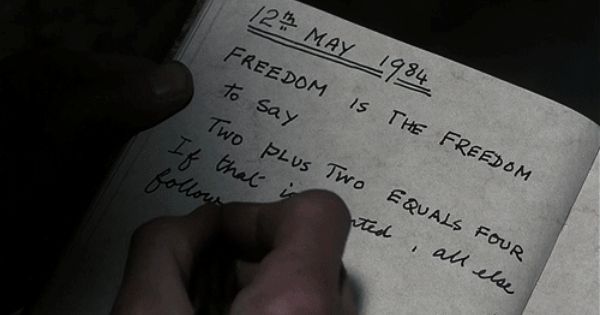
In the novel, the main character, Winston Smith says: Freedom is the freedom to say that 2 + 2 = 4

In BC today, Christy Clark’s  B.C. Liberal government  wants us to believe that 2 + 2 = 5.

They want us to believe that School Trustees are responsible for school closures.

They want us to believe that removing $4 200 000 000 from the education budget over the past 14 years means that they have “increased per student funding to the highest level”.

Perhaps the reason we have so much difficulty believing them is because we remember what happened to Oceania’s chocolate rations in Nineteen Eighty-Four:

It was therefore necessary to rewrite a paragraph of Big Brother’s speech, in such a way as to make him predict the thing that had actually happened. … Today’s issue contained a statement of the actual output, from which it appeared that the forecasts were in every instance grossly wrong. Winston’s job was to rectify the original figures by making them agree with the later ones. As for the third message, it referred to a very simple error which could be set right in a couple of minutes. As short a time ago as February, the Ministry of Plenty had issued a promise (a “categorical pledge” were the official words) that there would be no reduction of the chocolate ration during 1984. Actually, as Winston was aware, the chocolate ration was to be reduced from thirty grammes to twenty at the end of the present week. All that was needed was to substitute for the original promise a warning that it would probably be necessary to reduce the ration at some time in April.
From Nineteen Eighty-Four, Part One, Chapter 4

With so many of us having read  Nineteen Eighty-Four at school, the Government Communications and Public Engagement office certainly has their work cut out.

While they try to convince us about the benefits of the Prosperity Fund we’ll be thinking of the 20% of BC children who go to bed without a meal most nights a week.

While they try to get us to yes, we’ll be thinking no, committing thoughtcrimes as we do so.

Celebrate the Elimination of Provincial Exams?

provincial exams

If I wasn’t so familiar with the Ministry of Education’s Jekyll-and-Hyde character, I’d be thrilled with the new Graduation Program. After decades of frustration about the limits to student learning experiences that provincial exams set, I’d love to pop a champagne cork now that I am free of the fetters they placed on my lessons.  

The announcement of the changes has revived old arguments about what exams are for.  I must say that I disagree with the learned professor who believes that the removal of exams will lead to the dumbing down of learning. I happen to agree with my students that they don’t need to know the details of the Halibut Treaty in order to fulfill their responsibilities as citizens in a democracy. Many of the arguments that Dr. Livingstone makes have been made throughout the history of education whenever changes have arisen.  Plato himself lamented the rise of writing in place of dialogue. That was over 2000 years ago.

After decades of  feeling like a quisling every time I told my students how “important” studying for provincial exams was, I’ll happily let them know that they no longer will have to spend months memorizing the gajillion facts that they can instantaneously access on their personal devices.

But my joyful relating of this good news will be dampened by the knowledge that there is no funding to make possible the full implementation of the new curriculum.  It’s as though my students have been given the keys to a car without any money for insurance or gas or maintenance or even driving lessons.

The new curriculum requires more student-led activities but when schools are at or above 200% capacity where will teachers find the space for breakout rooms so that small groups of students can work together on projects?

Personalized learning is one of the core ideas in the new curriculum but with no Education Assistant support for students with special needs, how can one teacher provide personalized learning for all students in a class of 30?

Given the pattern of cuts that the Ministry has imposed on school district budgets, I suspect the elimination of some provincial exams is more of a political rather than a pedagogical decision. If it were purely pedagogical, the FSAs would be eliminated as well.

Contrary to what the Minister says about them being “valuable” FSAs only serve to highlight the socio-economic differences between schools. Unless and until the Minister is going to do something to alleviate those differences, they only serve to support the arguments of those promoting the growth of private schools.

After 15 years experiencing the BC Liberals’ brand of public education, I have a lot of difficulty believing that the Ministry makes any pedagogically-based decisions. Take a look at the mandate letter that Mike Bernier received from Christy Clark upon his appointment as Minister. His top task is to balance the ministerial budget. His final task (on a list of 13 items)  is to ensure that “taxpayer resources” are used “efficiently. Nowhere in his mandate letter is there any acknowledgement of barriers to learning such as a 20% childhood poverty rate in this province.

The provincial exams were indeed a barrier to my students’ pursuit of learning and I am pleased to see them gone. Each year my students take on the role of adult citizens when our classroom becomes a country. Through the process of electing a government and participating in an economy, they become curious about many things that will never be on the Socials 11 provincial exam: mercantilism, Machiavelli, Kant’s Categorical Imperative, egalitarianism, ethics. 

In the past I’ve only had enough time to guide them through brief glimpses of these and many other concepts so they have often been frustrated when discussions had to be stopped because we had to study the Statute of Westminster instead.

I am relieved that I will now be able to assess and evaluate my students in ways that fit their learning experiences. Perhaps that’s enough of a reason to celebrate the new Graduation Program. Perhaps.

B.C. Public School Supply List: Fall 2016

asbestos

For Immediate Release

Lower Mainland, BC

22 May 2016

PARENTS PREPARE TO PURCHASE ADDITIONAL SCHOOL SUPPLIES

Given the current state of many public schools in this province, and in light of the inadequate response by Premier Christy Clark’s government, parents of students in school districts with funding cuts are advised to prepare for increased spending on back-to-school supplies in Fall 2016.

School supply costs have been rising recently as BC Liberal government cuts to school district funds have resulted in fewer resources for classrooms. While teachers spend an average of $1200 per year on their classrooms, parents have been spending an average of $108 per child on traditional school supplies as well as about $150 on fundraisers throughout each school year.

This year however, parents are advised to budget  for additional expenses in the new school year to ensure their children’s safety while at school:

Suggested School Safety Supply List

  1. Water testing kit to check if your child’s school is one of the 92% likely to have lead in drinking water
  2. Hazmat suit to protect against asbestos contamination
  3. Reflective vests for long walks to school in the absence of schools buses or public transport
  4. Mask to protect against breathing in mould spores
  5. Mice/Rat traps (humane ones)
  6. Buckets to catch water falling through leaky roofs
  7. Personal fans/heaters to keep cool/warm in schools with aging heating/cooling systems
  8. Safety whistle to blow after earthquake so that recovery crews can locate survivors

“It’s scary how dangerous attending school in this province has become,” said Sue Parent. She went on to say that school used to be a safe place for children but for the past 15 years, she’s noticed that parents have become increasingly concerned about the BC Liberal government’s dereliction of duty regarding the health and safety of children in public schools.

Jane Parenting commented that when she went to school in the 1980s the only items her parents had to purchase were pencil crayons and a geometry set. She is alarmed at the changes in school supply lists that she’s seen over the past two decades.“When we were asked to supply photocopy paper that was bad enough but now the needs are simply shocking. One would think that it was the Ministry of Education’s duty to ensure that schools were free from mould, leaks and vermin,” said Jane. “I’m stunned that the Ministry does not seem to see that.”

Joe Taxpayer-Parent added that because parents were legally obliged to ensure the well-being of their children, they felt it necessary to purchase additional school supplies.

Ends

410 words

Contact

Bee Cee Voters

bcvote@bccitizen.com

123 Fiduciary Duty Avenue

Victoria, B.C

Privatizing Public Education, part two

private public park

As a technology corporation you have long been aware of Rupert Murdoch’s suggestion to invest in the education sector that is worth trillions of dollars. Unfortunately, as you are also aware, investment in this sector is particularly tricky and requires much patience.

By following the previous suggestions on how to lay the groundwork for investment, you will be ready for the implementation phase.  This phase too requires subtlety and a soft approach.

Priming

There are a few ways you can prime parents and the public into accepting privatization in schools.  One way is for corporations to provide resources either in the form of textbooks and other learning materials or in the form of cash that students and their parents earn when they purchase particular products.  Chevron’s Fuel your School is an excellent example of the latter.

Another way is to have teacher-run cafeterias replaced by those run by corporations such as Chartwells,  although profit is not always assured as was the case in New Brunswick.

A third way is to encourage corporations to support charitable handouts to schools as in the case of Postmedia’s Adopt-a-School program.

Of course vending machines in schools have long been a source of revenue for both the corporation and the school, and provide a good example of the kind of private-public partnership you want to encourage.

Framing

It’s necessary to have a public relations firm work with the politicians you are funding to ensure that they use language that frames the discussion of public education in a way that is favourable to the privatization project.

When your politician reduces the education budget, it’s important that she refer to members of the public as taxpayers.  Her message should be that she is concerned about taxpayer resources, that she wants to ensure that taxpayer money is not wasted.

However, in the event that the teacher union engages in strike action to force a settlement of their working conditions, it’s critically important that your politician speak of her concern for the inconveniences suffered by parents when schools are closed.

Budgeting

It’s useful to have your politicians enshrine balanced budgets into law.  The general public is law-abiding and intolerant of those who break the law. This is helpful when a rebellious group of school board trustees refuses to submit a balanced budget.  A media campaign that frames them as lawbreakers will distract the public from funding cuts.

Because all households are aware of the need to balance their budgets, it’s easy to convince the public that school districts need to do this as well.  Your politician should  be seen to be acting on behalf of the taxpayer and protecting their “resources” when she insists on a balanced budget.

Dividing

One can’t stress enough the necessity to ensure that groups of parents and teachers do not join forces.  This is why it’s critical that school rankings such as those provided by the Fraser Institute are vigorously defended. It’s unfortunate that in BC a school in Bountiful, where polygamy is practiced, was ranked highly when schools that provide breakfast programs and other social supports for students were not.

When the rankings get a lot of attention in the media, they are legitimized. Another benefit is that there is a spotlight focused on schools that are “failing” to meet the needs of students.  With the right media in place, this failure will be seen to be the fault of teachers and school boards.

Remember that the foundation of all business models is the provision of a service. It’s in the best interests of corporations that schools are seen to be failing. After all this was the reason given by Milton Friedman himself when he promoted the privatization of schools as a way to save public education.

Cautionary Note

You may encounter criticisms of your privatization project especially from those members of the public familiar with the failures of privatization in places such as Chile and in many parts of the United States.  The good news is that by the time the public cottons on to the flaws of privatization, your corporation will have already benefitted from government contracts and can then move on to new projects in other parts of the world.

Word is that Africa may be ripe for reaping should projects in North America fail.

Softly Selling the Privatization of Public Education

May be an illustration of text

When there’s news every day of yet another school district budget shortfall and yet another school being closed, it’s difficult to see what’s really been happening to public education in British Columbia for almost two decades now. But within the seeming chaos there is a clear pattern that emerges. It’s a pattern that can be clearly seen in many countries around the world as corporations turn their profit-hungry eyes toward the $5.5 trillion that is being spent on education worldwide.

Over a century ago public education was a radical idea in Britain. It was considered an utter waste of taxpayer’s money and was strongly resisted by many politicians. Nevertheless, arguments about public education being a public good won the day.

The big idea was that public education would provide an equal playing field for all society’s children.  Children from poor homes could work their way up the social ladder through a free education and this in turn would ensure that the state would benefit from having a well-educated workforce and citizenry.  Sounds all very democratic, doesn’t it?

Fast forward to the 1970s and a new idea began to spread from a group of economists at the Chicago School of Economics. One of them, Milton Friedman, wrote a seminal paper suggesting that public education be privatized.  For most people in North America this was an outrageous idea akin to suggesting that we should sell motherhood.  Because of the strong resistance to privatization of public education, it has to be sold to the public in a way that is subtle, is soft, is slick.  

HOW TO PRIVATIZE A PUBLIC EDUCATION SYSTEM

You will need the help of politicians. This is easy to obtain since they are always looking for donations for their election campaigns. Spending a few million will reap rewards ten times over. Once you have politicians on board, direct them thus: 

Competition

Erode the collaborative and co-operative foundations of public education by introducing competition between schools. As an example, in B.C.  the Fraser Institute began to rank schools in 1998 in a way that completely ignored multiple variables that made each school unique but that made sense to a public used to hockey team rankings.

Choice

Create a two-tier education system, one public and one private, both supported by public funds.  Keep increasing the amount of public funds that go to private schools while decreasing the funds that go to public schools. Watch while private schools advertise everything that public schools are accused of not having: small class sizes, new technology, support for students with learning disabilities.

Costs

Promote the idea that funding public education is too expensive and outside of the “affordability zone” for taxpayers. Keep changing the formula used to fund schools while you repeatedly tell the public that you’re increasing funding. They won’t realize that you’re spending less and less each year as you no longer fund things you used to fund in the past.

Count 

Insist that public schools be accountable. Insist that students be subjected to standardized tests like the FSA so that taxpayers can see whether they’re getting what they pay for. Ignore all the protests about standardized tests being invalid and that they don’t reveal anything of value regarding a student’s learning experiences.

Create Divisions

Implementing these steps needs to happen over a long period so that the pattern is not too obvious.  While you are waiting for the public to accept that privatization is good and is inevitable, it is also important to ensure that groups that may be natural allies, do not unite. It is therefore necessary to divide parents from teachers.  Use every opportunity to increase any dissension that may arise.

For example, when Parent Teacher Associations in BC were replaced by Parent Advisory Councils, teachers and parents moved to separate camps, so to speak, and this was good for the privatization agenda.  When the provincial body of PACs, the BCCPAC,  was led by those in support of accountability, this was also good for the privatization agenda since the perception was that the parents of 500 000 students were in support of the BC Liberal government’s education policies.

Speaking of perceptions, another important project is to change public perception of teachers.  There should be no limit on the budget spent on public relations in this regard. Painting teachers as greedy and lazy will turn public sentiment against them.

Also, support and encourage attacks on the teachers’ union. In BC, the attacks on the British Columbia Teachers Federation took the form of newspaper articles and editorials and also social media comments made by  digital influencers.  

You should also try to weaken teacher unions by other means. For example,  court cases that take over a decade to resolve.

Be Patient

Finally, patience is required for the privatization project since most people in society value public education and strongly believe that it’s a public good.

It’s the soft sell that will win them over.

Remember there is a big reward: a piece of that $5.5 Trillion pie.